
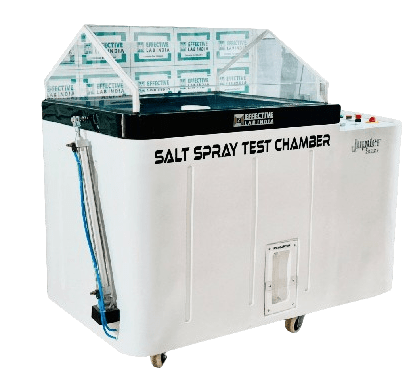
Salt Spray Test Chamber
When you are in a quality control laboratory testing coating resistance to corrosion, an automobile company testing parts, or an electroplating plant testing surface resistance to corrosion, you need the right salt spray chamber to perform your tests.
Our salt spray chambers have been designed from food-grade polypropylene (PP) bodies, stainless steel fittings, and an advanced PID temperature controller with microprocessor technology. All our salt spray chambers ship pre-calibrated and ready for ASTM B117 / ISO 9227 tests.
Over 500 chambers installed in India’s automobile, aerospace, and manufacturing industries give us the experience of understanding what your assembly line needs in terms of testing equipment. Our chambers are more than just chambers – they are a quality assurance tool.
A Corrosion Testing Chamber Built for Demanding Industrial Environments
The Salt Spray Test Chamber by Effective Lab India is an industrial salt spray chamber designed to conduct ASTM B117, NSS, ACSS, and CASS tests. Used widely by the automobile, aerospace, paint, and electroplating industries to test corrosion resistance.
Built to Withstand, Tested to Last
Ensure long-lasting protection with our Salt Spray Test Chamber, delivering reliable corrosion resistance
Regardless of whether you are a quality control laboratory checking for coating durability, an automobile company testing the performance of its components, or an electroplating company checking for surface quality, having the right salt spray test chamber is essential to your corrosion testing process.
Our salt spray chambers are built using microprocessor-controlled PID temperature controllers. All units are pre-calibrated and ready for ASTM B117/ISO 9227 testing.
Having supplied over 500 chambers in India's automobile, aerospace, and manufacturing industries, we know what your production line requires from corrosion testing chambers. This is not only a chamber but a quality assurance tool too.
What Is a Salt Spray Test Chamber?
A Salt Spray Test Chamber – also known as a salt fog chamber, salt fog chamber, or corrosion test chamber – is a lab-based environment designed to assess the corrosion resistance of metals, coatings, paints, and surface treatments. In a salt spray test chamber, a sodium chloride (NaCl) solution is atomized to create an accelerated corrosive environment, allowing years of environmental exposure to be simulated in just hours.
Salt spray testing is one of the oldest and most common types of corrosion testing available. Standardized according to ASTM B117 (which is regarded internationally as the benchmark test), salt spray testing offers a repeatable way of accelerating the corrosion process so that different coatings, plating finishes, and base materials can be compared.
From automotive and aerospace to consumer electronics and marine hardware industries, salt spray testing is used extensively to ensure that products meet required quality standards.
Working Principle (Step-by-Step)
Step 1 – Salt Solution Preparation
A solution of sodium chloride (NaCl) at 5% is prepared with demineralised water. The pH value is set between 6.5 and 7.2 by using reagent-grade chemicals. In the case of CASS testing, copper chloride and acetic acid are added.
Step 2 – Atomisation with Compressed Air
Compressed air (0.7 to 1.7 kg/cm²) passes through the spray tower nozzle, where it draws the salt solution and forms a uniform mist of 1-2 micron size.
Step 3 – Temperature Controlled Salt Fog Test Chamber
The test chamber is maintained at 35°C±2°C for NSS or 50°C for CASS. PID controllers maintain the stable environment during the entire test cycle.
Step 4 – Specimen Exposure
Specimens are hung at an angle of 15°-30° from vertical using non-conducting racks and exposed to salt fog continuously or cyclically for certain time period which could be 24, 48, 96, 240, or 500 hours.
Step 5 – Data Collection & Analysis
Test specimens are washed with clean water after testing and checked for blisters, rusting, delamination, or corrosion creep. Digital controllers record temperature, humidity, and run time automatically.
How does a salt spray chamber work?
Using the Corrosion Test Chamber is very simple, so even beginners can easily perform complex tests. Just follow these steps for the best results:
- Preparation: Begin by preparing the test samples according to the specific requirements of your industry standards. Ensure they are clean and free from any contaminants.
- Loading Samples: PCarefully place the samples inside the chamber, ensuring they do not touch each other or the chamber walls to avoid cross-contamination.
- Setting Parameters:Program the chamber with the required parameters such as temperature, humidity, and duration of the test. These parameters are crucial and should be set according to the standards you are adhering to.
- Starting the Test:Initiate the test cycle. The chamber will spray a fine mist of salt solution, simulating a corrosive environment.
- Monitoring:Regularly monitor the progress through the observation window or digital display. Ensure the chamber maintains consistent conditions throughout the test.
- Post-Test Analysis: Once the test is complete, remove the samples and analyze them for signs of corrosion.
What is the Salt Spray Chamber Price in India?
The pricing of the salt spray chamber varies differently. There are several manufacturers which offer several prices for this instrument. This price ranges from country to country. In every country, the price should be different. The typical price of Salt Spray Test Chamber in India ranges from around ₹ 70,000 Thousands to ₹ 8,00000 Lakh.
Conclusion
Salt spray test machines are an essential tool for ensuring the durability and reliability of products across numerous industries. Effective Lab India, with its cutting-edge technology, expertise, and customer-focused approach, stands out as a leading manufacturer in India, offering solutions that meet both standard and specialized testing requirements.
For More Information, please reach out to us.
Contact: +91 93554 43334
Email: info@effectivelabindia.com
LinkedIn: Effective Lab India
| Chamber Temperature Range | Ambient to 40°C |
|---|---|
| Power | 220V, Single phase, 50Hz, 15 A |
| Test Air Pressure | 0.7kg/cm²-1.2kg/cm² |
| Test Chamber Temperature Range | 35°C ± 2°C |
| Chamber Temperature List Count | 0.1°C |
| Temperature Control | Inbuilt PID Temperature Controller |
| pH value of Salt Solution | 6.5 to 7.2 pH |
| Air Saturator Temperature Least Count | 0.1ºC |
| Air Saturator Temperature Repeatability | ± 2ºC |
| Available Size | Models |
| 1 | Digital - 250 |
| 2 | Digital - 300 |
| 3 | Digital - 450 |
| 4 | Digital - 1000 |
| Inner Dimensions (mm) | Outer Dimensions (mm) |
| 780mmX620mmX720mm | 1540mmx1070mmx1300mm |
| 800mmx570mmx700mm | 1600mmx280mmx1350mm |
| 950mmx700mmx720mm | 1800mmx1250mmx1250mm |
| 1600mmx800mmx800mm | 2500mmx1200mmx1550mm |
- Various grades of metal can be easily tested.
- For an effective mode of operation, digital controls are provided.
- The results of testing are highly accurate.
- It is structured with strong rigged material for effective testing.
- Data management is easy which allows the machine to function smoothly.
- Designed in compatibility with industrial standards.
- Timer functions which provide results accuracy.
- Specific temperatures can be set for testing.
- Transparent Canopy for see inside process.
Know About Our Products
Get to know our Laboratory Testing Equipment, designed with precision and excellence to meet the highest industry standards. Each product in our range is crafted to offer superior performance, durability, and innovation, ensuring they meet the diverse needs of our customers.
The Salt Spray Test assesses the corrosion resistance of metals and coatings by exposing them to a controlled salt fog environment. Crucial for industries like automotive, aerospace, and marine, it helps manufacturers evaluate the durability and longevity of their products under harsh conditions
Salt Spray Testing is a widely used corrosion testing method that simulates the effects of a corrosive environment on materials. By exposing test samples to a dense salt mist in a controlled chamber, this method assesses the resilience and longevity of coatings and metals. Crucial for industries like automotive, aerospace, and marine, it ensures material durability, reduces maintenance costs, and guarantees safety by predicting how materials will perform under harsh environmental conditions.
Salt Spray Testing is a widely used corrosion testing method that simulates the effects of a corrosive environment on materials. By exposing test samples to a dense salt mist in a controlled chamber, this method assesses the resilience and longevity of coatings and metals. Crucial for industries like automotive, aerospace, and marine, it ensures material durability, reduces maintenance costs, and guarantees safety by predicting how materials will perform under harsh environmental conditions.
The following parts can be salt spray tested.
- ED coating parts
- Painted Parts
- Phosphate Parts
- Powder Coating Parts
- Zinc Plating and Zinc Alloy Platings
The Salt Spray Test Chamber plays a critical role in product development and quality assurance. By simulating harsh environmental conditions, it helps in: Enhancing Product Durability: Identifying and mitigating potential weaknesses in materials and coatings. Meeting Industry Standards: Ensuring products comply with international standards for corrosion resistance. Improving Customer Satisfaction: Delivering reliable and long-lasting products to end-users.
Contact Form
Connect with us will help you with their queries...
For accurate laboratory testing results? contact us
for high-quality testing equipment solutions.