
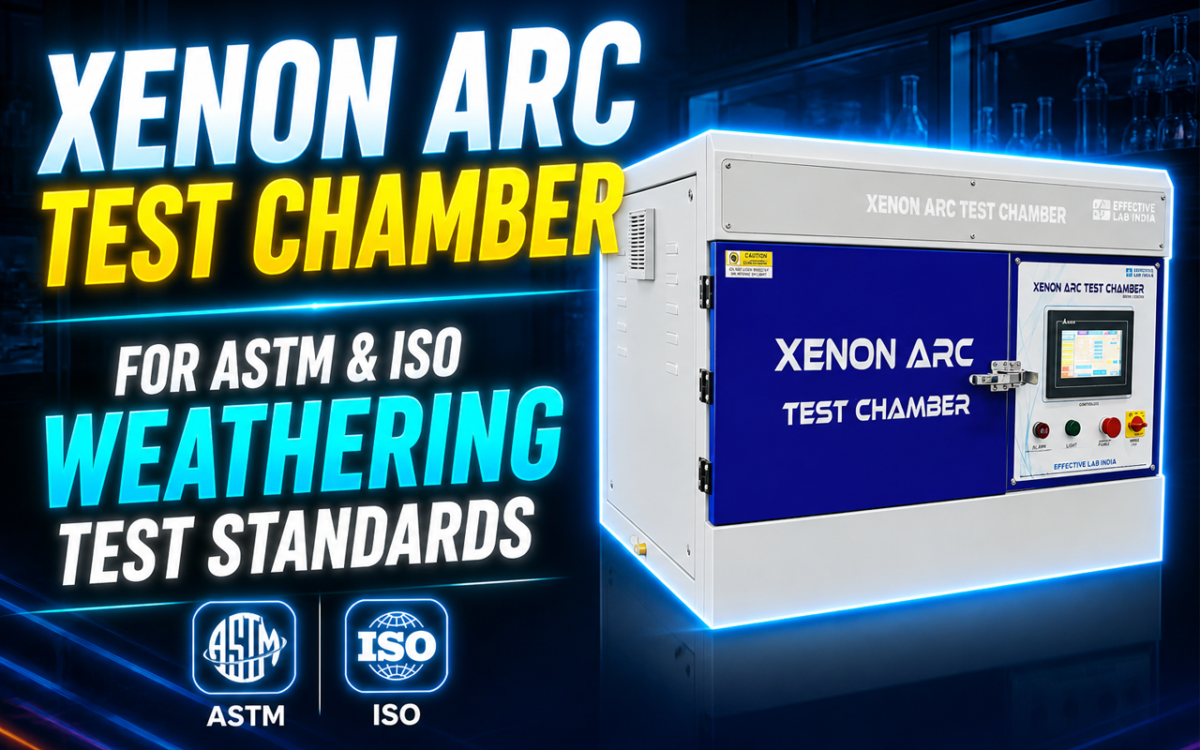
What Is Xenon Arc Testing?
Xenon arc testing is considered the most advanced method of recreating the entire sunlight spectrum – from ultraviolet (UV), through visible light, to infrared – in a laboratory setting. As opposed to fluorescent UV lamp systems that simulate UV rays alone, xenon arc lamps recreate a continuous spectrum that mimics natural sunlight from 290 nm all the way to more than 800 nm. For this reason, xenon arc testing has become the most reliable method for estimating material performance and degradation throughout its lifetime when exposed to the outdoors.
The Xenon Arc Test Chamber by Effective Lab India goes one step further and adds moisture and temperature simulation capabilities to UV testing in order to speed up the material aging process and provide repeatable, compliant test results in a very short period of time. With an aging test cycle performed within days or weeks, instead of years in the real world, manufacturers save considerable time on the product development process and ensure quality.
Some of the industries that require xenon arc UV testing are automotive industry, aerospace industry, paints and coating industry, plastics industry, textile industry, construction industry, and electronic industry. Whenever your product has been exposed to sunlight throughout its entire lifetime, xenon arc testing is the only method you have to prove its durability.
Xenon Lamp Aging Tester
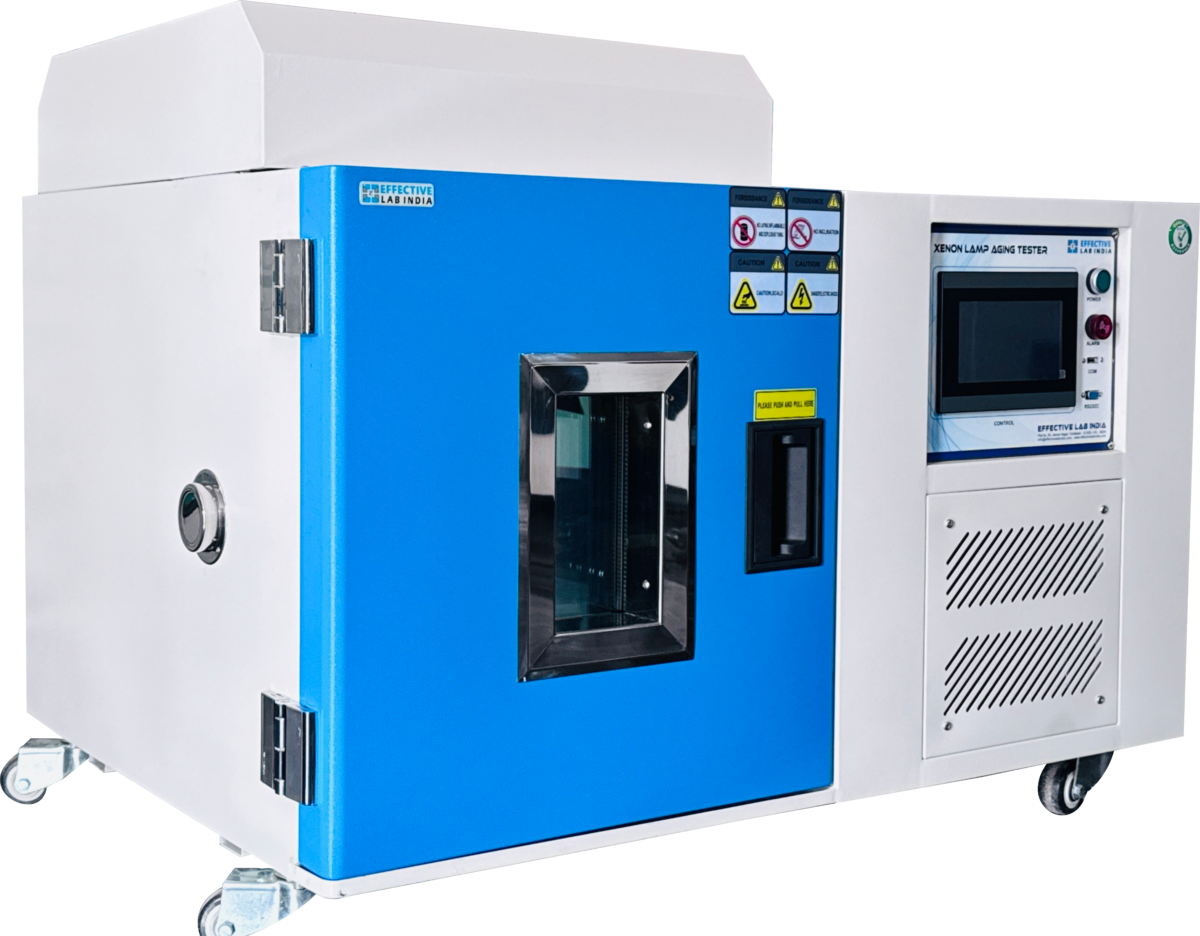
A xenon lamp aging tester (also called a xenon arc weathering tester or xenon weathering chamber) is a laboratory test instrument used to simulate outdoor weather (sunlight, heat, humidity, rain). Effective Lab India offers high quality of xenon arc lamps which allowing manufacturers to test how products degrade under prolonged exposure to light, heat, humidity and weather. It is commonly used in various used in various industries like automotive, textile, paint, plastic, etc. where it tests the product’s lifespan.
Suggested Product:
CASS Cum Salt Spray Chamber
Bench UV Light Accelerated Weathering Chamber
Suggested Post:
Xenon Arc Lamp Explained – The Science Behind the World’s Most Powerful Artificial Light
Defend Your Products from Corrosion
Advanced Corrosion Salt Spray Chamber for rigorous testing, ensuring durability in harsh environments
Why Xenon Arc Testing Is the Industry Gold Standard
Accelerated weathering tests are not all the same. Your choice of light source is absolutely crucial to how well your test results match outdoor reality.
This is how xenon arc testing trumps other methods.
Solar Spectrum Simulation Capability:
The xenon lamps provide the complete spectrum of the sun’s rays – from UV to visible to infrared radiation.
- The use of optical filters (such as those for sunlight or glass) enables the adjustment of the spectral distribution in accordance with various test applications – outdoors or inside with glass transmittance.
- Conversely, fluorescent lamps emit only ultraviolet radiation and cannot replicate the visible and infrared spectra that cause degradation in some samples.
Controlled Irradiance Level:
- The lamp output irradiance level is controlled via feedback control circuitry to ensure a constant UV dose during exposure testing.
- Irradiance can be varied from 0.5 to 2.0 W/m² at 340 nm to enable acceleration factors appropriate to certain climates.
Multi-Stress Exposure Capability:
- Different levels of temperature, humidity, and water spray can be controlled and cycled simultaneously with the UV exposure for realistic testing conditions.
- Multi-stress capability is crucial when testing materials that experience more than one stress simultaneously, such as automotive paint.
International Standard Compliance:
- Xenon arc testing is mandated by ASTM G155, ISO 4892-2, ISO 105-B02, SAE J2527, and many OEM-specific specifications that cannot be met with any other light source.
Effective Lab India: Your Trusted Xenon Arc Test Chamber Manufacturer
Effective Lab India is a major manufacturer, supplier, and exporter of environmental testing instruments based in Faridabad, Haryana. Backed by a high-end manufacturing unit along with an in-house team of expert researchers and developers, we develop Xenon Arc Test Chambers with specifications that comply with the needs of contemporary quality laboratories in terms of technical accuracy, user-friendliness, and durability.
The Xenon Arc Test Chambers from Effective Lab India are engineered for reliability. Every model is put together by expert engineers who undergo a thorough performance test before dispatch, and all necessary technical documentation, such as calibration certificates, operating manuals, and international compliance reports, is provided. We not only supply quality laboratory instruments but also assure our clients of accurate and internationally acknowledged test results.
Why Customers Across India Choose Effective Lab India:
- Extensive experience in environmental and aging testing instruments like xenon arc tester, UV tester, salt spray tester, ozone tester, and humidity chamber tester
- ISO-compliant quality control during manufacturing, with stringent quality checking procedures during in-process and post-process
- Exclusive research & development for product up-gradation and standards update
- Nationwide service network with services like installation, commissioning, calibration, and maintenance services
- Competitive pricing policy without any hidden charges, with every instrument supplied with relevant documentation
- Customization for non-conventional sizes and types of filters, and customized orders for OEMs
- Operator training service is provided on-site, free with every installation service
Our Xenon Arc Test Chambers are competitively priced between ₹4,00,000 to ₹8,00,000 based on model and configuration.
Xenon Arc Test Chamber: Product Overview & Key Features
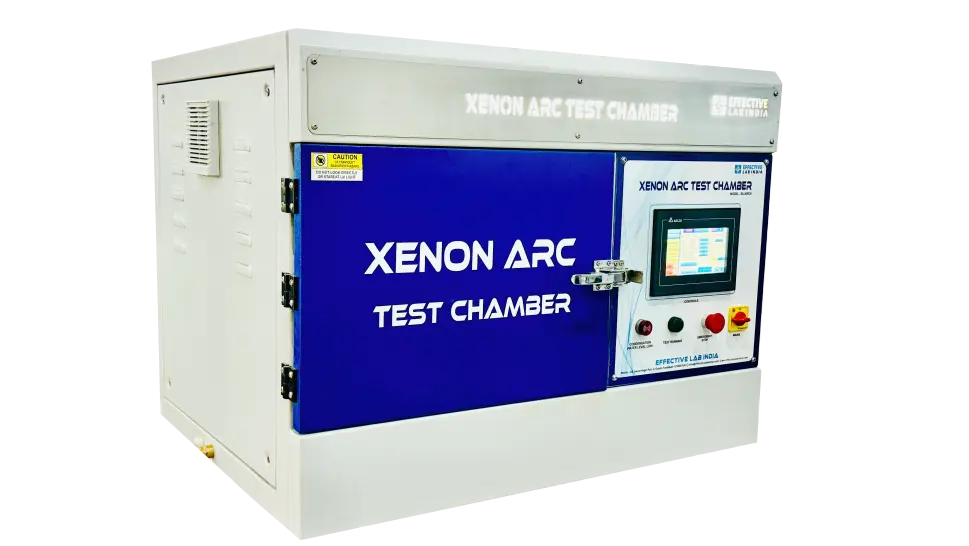
The Effective Lab India Xenon Arc Test Chamber is a top-quality, independent weathering test machine fitted with a 1.8 kW xenon arc lamp, identical to those used in qualifying tests by automobile manufacturers and coating suppliers across the globe.
The test chamber offers a surface exposure area of 1,000 cm² and a capacity to hold nine specimens of standard size (150 × 70 mm). Programming of sophisticated test sequences, real-time test monitoring, and test data logging are made convenient by the 7-inch HMI touchscreen interface.
One of the most outstanding features of the Effective Lab India Xenon Arc Test Chamber is the optical filter system. One can choose between a daylight filter for direct sunlight exposure and a window glass filter for indoor light exposure through glass. With this, the instrument caters to various applications in xenon arc UV testing.
Advanced Control & Monitoring Features:
- HMI touch screen display: latest 7” coloured display for efficient test programming and real-time monitoring
- Irradiance regulation: regulated from 0.5-2.0 W/m² for 340 nm wavelengths; overall spectrum 50-120 W/m² (300-400 nm)
- Temperature regulation: adjustable from RT+30°C to 80°C with individual PID regulation
- Preset test timer and programmable cycle options for automatic long-term xenon arc test cycles
- Test status display screen along with digital displays of accumulated exposures, temperatures, and spray times
- Automatic test cycle initiation with simple touchscreen parameter settings
Optical & Lamp System:
Optical & Lamp System:
- 8 kW xenon arc lamp with a rated life of 1,500 to 2,000 hours
- Daylight filter and window glass filter — both included to support multiple test standards
- Continuous irradiance monitoring with automatic lamp power adjustment to maintain the set irradiance
Specimen & Chamber Design:
Optical & Lamp System:
- 1.8 kW xenon arc lamp with an operational life span of 1,500 - 2,000 hours
- Daylight filter and window glass filter – both present to allow the implementation of several testing standards
- Irradiance control with an automatic correction of lamp power to keep a steady value of the irradiance
Specimen & Chamber Configuration:
- Testing Area: 1,000 cm²; Specimen Holding Capacity: 9 pieces (150 x 70 mm each)
- Installed a water sprayer system to conduct simultaneous tests using UV and moisture
- Small-sized chamber (dimensions: 780 x 580 x 1,040 mm), allowing a compact presence in a laboratory
- Weight: 97 kg – heavy, stationary device for vibrationless functioning
How Does Xenon Arc Testing Work? Step-by-Step Process
The importance of knowing how the xenon arc UV test works allows test operators to properly configure and evaluate results. Below is an explanation of the test cycle in a xenon arc chamber:
- Optical Filter Selection: Depending on whether your material will be exposed directly under sunlight outdoors or indoors, select the proper optical filter, either a daylight filter or a window glass filter.
- Sample Preparation & Placement: Cut samples into a 150 × 70 mm size (or place entire components), and place them inside the sample holders located in the exposure section.
- Test Program: Set up all test parameters like irradiance set point, chamber temperature, spray intervals, and overall duration of test using the HMI touchscreen.
- • Xenon Arc UV Exposure Phase: The specimens are exposed to the 1.8 kW xenon arc lamp with a controlled, continually adjusted irradiance. This is accomplished via a closed-loop irradiance control system that compensates for age-related changes in lamp power automatically.
- Moisture / Water Spray Phase: Every once in a while, the water spray system is switched on to create rain, dew, or humidity effects. The temperature is separately regulated using the PID control.
- Data Recording and Monitoring: Irradiation dose accumulated during the process, chamber temperature, spray duration, and overall duration of testing is displayed in real time on the HMI. The results of testing can be saved for documentation purposes.
- Testing: Once the xenon arc exposure phase is completed, samples are evaluated according to one of the failure criteria listed below, which are set by the relevant standard.
International Standards for Xenon Arc Testing
The Efficient Lab India’s Xenon Arc Test Chamber can be used to conduct xenon arc testing according to the following international test methods:
- ASTM G155 - Practice for Operating Xenon Arc Light Apparatus for Exposure of Non-Metallic Materials
- ASTM G151 - Practice for Exposing Non-Metallic Materials in Accelerated Test Devices
- ISO 4892-2 - Plastics - Methods of Exposure to Laboratory Light Sources – xenon arc lamps
- ISO 105-B02 - Textiles - Tests for colour fastness to artificial light – xenon arc fading lamp test
- ISO 11341 - Paints and varnishes – Artificial weathering and artificial irradiation – exposure to filtered xenon arc radiation
- SAE J2527 - Performance-based test procedure for accelerated exposure of automotive exterior materials using a controlled irradiance xenon arc apparatus
- SAE J2412 - Accelerated exposure of automotive interior trim components using a controlled irradiance xenon arc apparatus
- DIN EN ISO 4892-2 - European harmonized edition of ISO xenon arc test
These methods will ensure that your test data is recognized across the globe by OEMs, certification agencies, and other governing bodies to safeguard your exportability and reputation.
Industry Applications of Xenon Arc UV Test
Xenon arc UV test is a requirement or recommendation for a wide variety of industries where the product is expected to be subjected to sunlight or ultraviolet-rich artificial light source exposure in its usage period:
- Automotive Exterior: Vehicle paintwork, body work, plastic bumpers, headlamps, rubber seals, and chrome parts as per SAE J2527 standards
- Automotive Interior: Interior plastics, dashboard plastics, upholstery, carpets, and headliner fabric – SAE J2412 standards using window glass filters
- Architectural Coatings: Outdoor paint, primer, wood coating, and anti-corrosion coating according to ISO 11341 and ASTM G155 standard
- Textiles & Clothing: Colorfastness test of textile materials used in awnings, sports clothes, and other outdoor clothing materials as per ISO 105-B02
- Plastic and Polymer: Plastic materials like PVC, polycarbonate, polypropylene, acrylate, and acrylic materials have resistance to UV exposure
- Construction Materials and Products: Roof membrane, windows, wall panel, sealant, and building adhesives
- Electronic Components & Assemblies: Housing, cover material, cable insulation, potting compound
- Medical Devices: Polymer housing and UV-exposed medical device component subjected to biocompatibility testing post weathering
Frequently Asked Questions (FAQs) About Xenon Arc Testing
Q: What is the difference between xenon arc testing and UV fluorescent lamp weathering testing?
Answer: Xenon arc aging test involves using a xenon arc lamp together with optical filters to simulate the entire solar spectrum, including ultraviolet, visible light, and infrared radiation.
This test is more correlated with outdoor exposure. The aging test using a UV fluorescent lamp involves simulating just the ultraviolet part of sunlight.
It is less correlated with outdoor exposure than the xenon arc aging test since some substances are degraded by visible and near-infrared radiation in addition to ultraviolet light.
Xenon arc aging test is preferred in applications where correlation with outdoor exposure is important such as automotive OEM qualification, exterior architectural coating, and textile colorfastness.
Q: Which international standards does xenon arc UV testing comply with, and how do I know which one applies to my product?
Answer: The most frequently used xenon arc testing standards are ASTM G155 (for general non-metallic materials), ISO 4892-2 (for plastics), ISO 105-B02 (for textile color fastness), ISO 11341 (for paints and coatings), SAE J2527 (automotive exterior), and SAE J2412 (automotive interior).
Depending on what kind of material you are dealing with and the requirements of your customers or certification agencies, the applicable test standard may differ. For exports to Europe, it is more common to use ISO standards, while automotive OEMs in North America use SAE standards.
In case of doubt about the applicability of the test standard, our technical team at Effective Lab India can help select the suitable test procedure, filter type, irradiance level, and duration of the test.
Q: How often do the xenon arc lamp and filters need to be replaced, and does Effective Lab India provide spare parts and after-sales support?
Answer: The life span of the 1.8 kW Xenon Arc Lamp used in the Effective Lab India chamber ranges from 1,500 to 2,000 hours. The actual life span depends upon several factors.
The HMI device keeps track of the number of lamp hours. Replacing the lamps once they reach the specified life expectancy helps ensure irradiance accuracy. Optical filters need to be regularly checked to detect any loss in efficiency due to solarization.
Filters need to be changed in case their transmittance deviates from the stated specifications. Replacement lamps and filters, including daylight and window glass, along with other consumables, are supplied by Effective Lab India directly.
Ready to Invest in Professional Xenon Arc Testing?
If you are planning to establish a new weathering test lab, upgrade from a fluorescent UV system to a xenon arc test box that provides full-spectrum exposure, or just searching for a second one, then Effective Lab India can provide you with both knowledge about the equipment and assistance through the sales process and installation.
We will be happy to assist you in choosing a filter and preparing a test program that meets your customers’ demands.
| Xenon Lamp | A 1.8KW iXenon lamp |
| Fliter | Daylight filter or Windows Glass filter |
| Lamp Lifetime | 1,500~ 2,000 hours |
| Exposure Area | 1,000 cm2 |
| Capacity for Standard specimen( 150×70cm) | 9 pieces |
| Adjustable Irradiance range | 0.5~ 2.0 W/m2 (Single point of control: 0.35~ 1.0 W/m2340nm) (Single point of 50 W/m2~ 120 (Full spectrum :from 300~ 400nm) |
| Adjustable testing temperature range | RT+30? ~ 80? |
| Power Supply | 220V 50/60HZ; 12A |
| Max. Rated Power of Chamber | 2.5 KW |
| Dimension (L×W×H ) | 780×580×1,040 mm |
| Net Weight | 97 KG |
- Excellent system control with latest HMI touchscreen
- Maintains rapid resumption of Xenon lamp during continuous circulation
- Temperature setting and Preset Timer functions incorporated in HMI for accuracy and repeatability.
- Program profile for selecting test parameters and performing the test.
- Current test running status display
- Xenon Lamp to simulate short-wave ultraviolet part of sunlight
- Digital display of test time, chamber temperature, spray time, accumulated time.
- Fully automatic test cycle after settings through Touch Screen control
Know About Our Products
The Xenon Arc Test Chamber offers precise, multi-environment testing by combining salt spray with humidity, drying, and condensation cycles. It rigorously simulates harsh conditions to assess material durability, ensuring your products withstand corrosion and deliver long-lasting performance in challenging environments.
It is a testing equipment used for testing the durability and exposure of sunlight to the products. This test chamber uses a xenon arc lamp as a light source, that’s why it is known as a Xenon arc test chamber
The wavelength of a xenon arc depends on specific conditions, It typically ranges from ultraviolet to visible light.
Xenon arc test chamber has several benefits. The most common use of xenon arc is in lighting because it produces intense and bright light which is similar to natural sunlight. Moreover, Xenon has several uses and benefits in anesthesia and medical imaging.
Different standards of xenon arc testing depend on the specific industry. Some commonly used standards include ASTM G155 and ISO 4892. These standards help in providing guidelines for testing the performance and durability of materials under simulated exposure to sunlight. Moreover, you need to consult the specific standard according to your industry for accurate results of testing



Contact Form
Connect with us will help you with their queries...
For accurate laboratory testing results? contact us
for high-quality testing equipment solutions.