

BOD Incubator: Understanding The Complete Diagram Every Lab Student Needs
April 8, 2026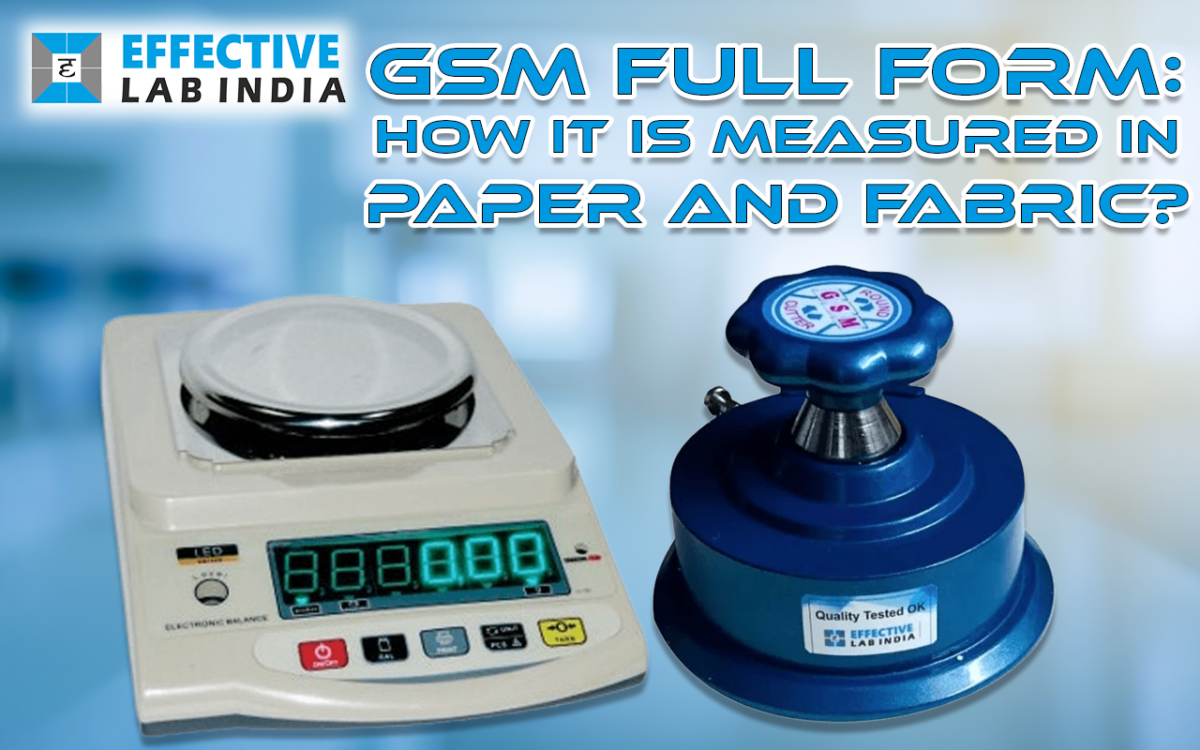
GSM Full Form: If you are one of those who have ever held a business card and become aware of its thickness or recognized that a premium notebook feels weightier than its normal counterpart, then you must have already been introduced to GSM. GSM is perhaps one of the most basic yet least understood quality parameters in both the paper and fabric industries. It governs how a material feels, performs, and is priced. GSM is a basic concept that all the manufacturers, buyers, quality control experts, and laboratory technicians should understand.
And at Effective Lab India, we manufacture and supply precision instruments for accurate measurement of GSM in paper, board, fabric, and other sheet materials. Our instruments are reliable in working quality laboratories in India and are exported globally
The Invisible Quality Check Hidden in Every Sheet of Paper
Table of Content
- 1 The Invisible Quality Check Hidden in Every Sheet of Paper
- 2 The Metric That Paper Experts Know About GSM Before Buying Paper
- 3 Paper & Fabric Industries Depend on It
- 4 Understand The Industry Standard Paper & Fabric
- 5 GSM Round Cutter Machine: Where Precision Meets Performance
- 6 Digital GSM Balance: The Ultimate Weight Measuring Tool for Paper & Fabric
- 7 FAQs
- 8 Conclusion on Measuring GSM in Paper and Fabric
Penned GSM, which stands for Grams per Square Metre. It is the basic unit used to indicate how much paper, cloth, or any surface material weighs per square metre. The GSM value tends to weigh more and is generally thicker. A lower GSM will result in a lighter and thinner sheet.
GSM is also not an arbitrary number — it provides a measure of quality. It tells you if a paper will bleed through ink, if a fabric will hold its shape, and if a packaging board can withstand transit. Although indistinguishable to the naked eye, GSM is by far the most crucial specification that is verified before any paper (or fabric) can be approved for production and purchase.
Standard office printing paper has a GSM of, on average, 70 to 80. Top-quality letterhead paper has a range of 90 to 120 GSM. Visiting cards and such thick cardstock normally range from 300 to 400 GSM. In fabric, a lightweight summer shirt might be 100 to 150 grams per square meter (GSM), and heavy denim may be over 400 GSM.
The Metric That Paper Experts Know About GSM Before Buying Paper
GSM is the first specification that gets discussed before any purchase order in the paper or packaging industry. GSM is used by paper experts and those in purchasing departments to compare one material from a supplier against different suppliers, validate batch-to-batch consistency, and validate product compliance with customer requirements.
This is why GSM is very important before purchasing a paper:
- GSM: the higher the GSM, either 170 or 210, the higher the print quality. If the paper has too low a GSM, ink may seep through or bleed onto the other side of the page, ruining double-sided print jobs. A thicker GSM paper absorbs ink more consistently for sharper, cleaner prints.
- Packaging Strength is also closely linked to GSM. boxes, cartons, and kraft paper bags have their own GSM range to carry certain weight and ensure the protection of the contents inside.
- The paper industry calculates its cost according to the GSM. Paper is sold by weight, and therefore a higher GSM paper will cost more per sheet but may be a better value overall depending on the application. Buyers who know GSM can negotiate better and not overpay.
- In Compliance and Standards for many industries, certain GSM ranges have to be met by the paper or fabric materials. There are set GSM specifications for the topics of pharmaceutical packaging, food-grade packaging, and textile exports, and these must be checked before product shipment.
Paper & Fabric Industries Depend on It
GSM is not specific to the paper industry. GSM is the prime quality trait in the fabric and textile industry as well. From woven and non-woven fabrics to technical textiles and specialty materials, GSM is what indicates whether a fabric is fit for the purpose it needs to serve.
GSM testing is used in the paper mill for newsprint, writing paper, tissue paper, kraft paper, duplex board, corrugated flute, and coated paper. Define GSM Ranges for Each Product Category —Introduction of the desired GSM range for the corresponding product category helps in reducing Customer complaints and misalignment, causing machine jams (printing presses) or structural failure (packaging).
GSM testing is widely used in cotton, polyester, blended fabrics, denim, fleece, nonwoven geotextiles, filter fabrics, and technical textiles. You may lose the warmth, coverage, and durability that you expected by using a fabric that is lighter than specified. A heavier fabric than the specified weight can be overly stiff, too expensive, or inappropriate for a garment or application.
GSM measurement in both industries follows the same principle — cut a standard area of the material, weigh it to a high degree of accuracy, and divide that by the area (in square metres). This is the measurement of which the accuracy entirely depends on the quality of the instruments used.
Understand The Industry Standard Paper & Fabric
So, a GSM Round Cutter Machine and a GSM Balance are used together as standard laboratory instruments to measure GSM accurately and quickly. These two instruments form a pair and are the industry standard for GSM testing in both paper and fabric laboratories.
The process is straightforward:
- The Task – Initial Cutting: Using the GSM Round Cutter Machine, we cut out a circular specimen of a precisely defined area from the material. As the cutter is designed to cut samples from an area of known extent — usually 100 cm² — it allows for a direct conversion of weight to GSM via a single multiplication factor.
- The second step in this method involves placing the cut sample on a GSM Balance, which measures to give either the direct GSM value or allows the operator to calculate it. Digital GSM balance removes manual calculation error and gives immediate, accurate readings.
When done with precision instruments, this two-step process is simple, fast, and highly accurate. It is used globally by paper mills, corrugated box manufacturers, textile mills, packaging companies, quality testing laboratories, and export inspection agencies.
Suggested Post:
BOD Incubator: Understanding The Complete Diagram Every Lab Student Needs
ASTM Full Form & B117 Learn: Accurate Salt Spray Results
Bursting Strength Tester Manufacturer: Everything You Need to Know
GSM Round Cutter Machine: Where Precision Meets Performance
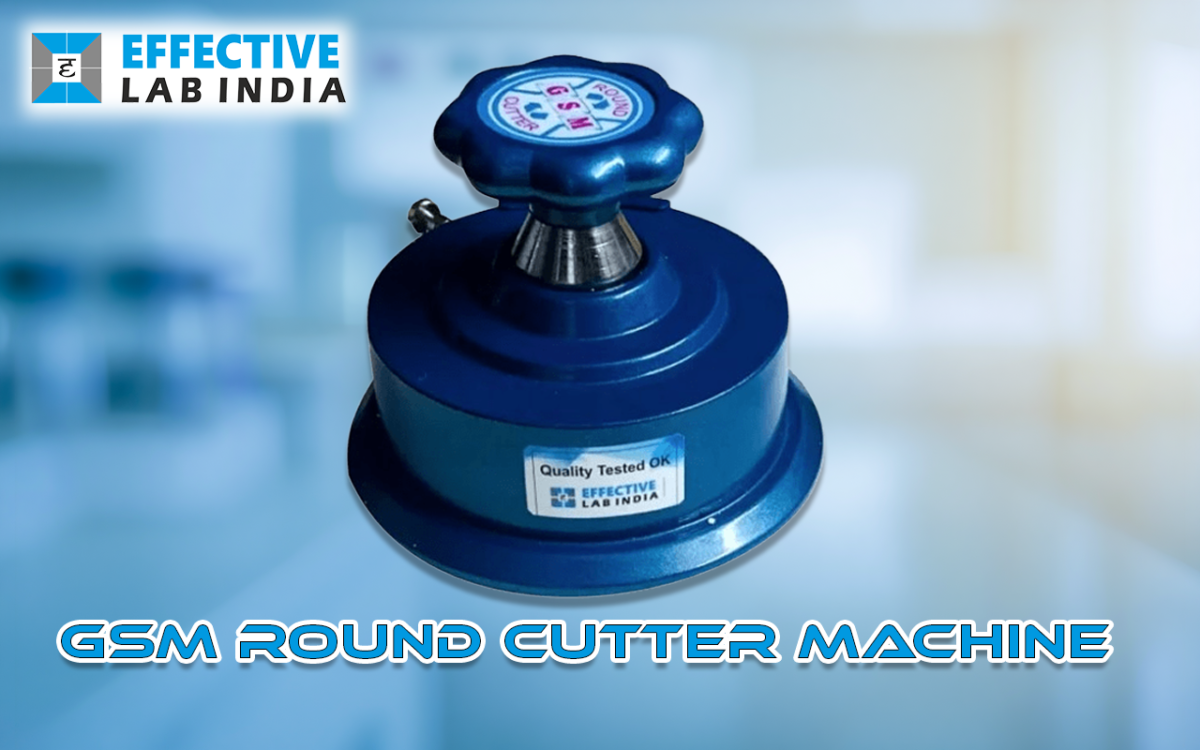
The GSM round cutter machine that we manufacture at Effective Lab India is a cutting-edge tool used to make perfect circular samples from all types of sheet materials, such as paper, board, and others. A circular blade slices out a section of precisely 100 cm² from the sample, which is the arbitrary area used for GSM computing.
GSM Round Cutter Machine Features:
Its heavy-duty hardened steel cutting blade retains its sharpness for 1000’s of cuts, so you get the same size sample every time. The cutting action is smooth and has a low operator load, reducing fatigue in high-volume testing environments.
It will either hold the material in place via the base plate during cutting or allow for a size of variable sample sizes, which can cause slippage. Any change in the size of the sample gives rise to a wrong reading of radiance per meter, independently, which makes the base plate stability a critical aspect in its design.
The unit is solid, compact, and maintainable. It does not need to plug into an electrical outlet, so it can be used anywhere in the lab or on the production floor. Replacement blades are inexpensive and easy to install.
The GSM Round Cutter is ISO 536 compliant with TAPPI T-410 and other international paper grammage testing standards, making it perfect for certified testing labs and export compliance testing.
Digital GSM Balance: The Ultimate Weight Measuring Tool for Paper & Fabric
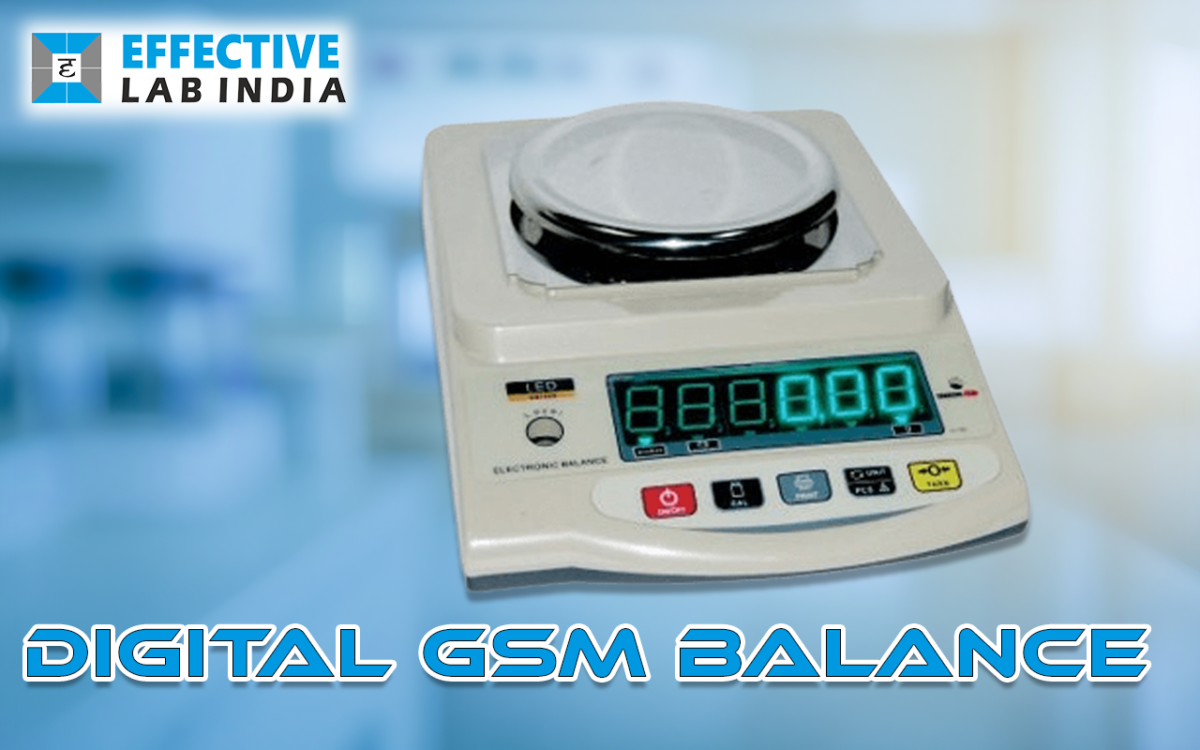
The next step after cutting a circular sample is to weigh it precisely. For this, the Effective Lab India Digital GSM Balance is the best product. A GSM balance is calibrated to provide direct readings of the GSM value when a 100 cm² sample is placed on the pan, eliminating calculation time and providing greater accuracy than a laboratory balance.
DIGITAL GSM BALANCE — Main features
The scale has a high resolution, which means it reads to within four decimal points, making sure that even the slightest drop in sample weight is detected. Such accuracy is important when testing lightweight papers and thin fabrics, where GSM differences of 1 to 2 grams make a substantial difference in quality.
It has an automatic zero calibration and a tare feature for quick resetting of the balance between samples. An integrated overload protection system protects accurate weighing operations from damage due to accidental overloading.
In addition, its digital interface is friendly and intuitive, allowing laboratory technicians to easily operate it even without extensive training. Data Output Options: Readings recorded can be exported for quality documentation and reporting.
Model: GSM Balance Digital. Our digital GSM balance is in accordance with international weight standards and is used across paper mills, textile manufacturers, packers, and quality control lab in India and export markets worldwide.
FAQs
Q1. What is the full form of GSM?
GSM is short for Grams per Square Metre. It is the unit used for quantifying the mass of paper, fabric, or other sheet material with respect to one square metre.
Q2. What is the significance of GSM in the paper industry?
GSM determines your paper weight, thickness, strength, and print quality. The application is also used for quality control, compliance testing, cost calculation, and supplier comparison across the paper and packaging industry.
Q3. How is GSM tested in a lab?
To determine GSM, a 100 cm² round-cut circular sample is cut with the GSM Round Cutter Machine and weighed with the Digital GSM Balance. The balance shows the GSM value directly; if not, it is calculated from the sample weight and area by the operator.
Q4. What is the normal GSM of office printing paper?
Standard printer paper has a GSM of 70 to 80. Some writing papers range between 90 and 120 GSM, some thick cardstock can range from 300 to 400 grams, or visiting cards.
Q5. The GSM is also used in the fabric industry. Yes. This unit of GSM is frequently used in the textile and fabric industry to measure the weight of woven fabrics, knitted materials, nonwoven products, denim/ fleece, and technical textiles. This is important for understanding the suitability of a product for certain applications, as well as in maintaining batch-to-batch consistency during production.
Conclusion on Measuring GSM in Paper and Fabric
GSM is a low number that packs an immense punch — both physically and conceptually — in the paper and cloth worlds. Whether you are a manufacturer, a buyer, or work in quality control, you need to understand GSM and how to measure it accurately. Our GSM Round Cutter Machine and Digital GSM Balance at Effective Lab India are designed to provide a level of precision, reliability, and ease of use not seen in the modern quality laboratory. to learn more about our instruments or to request a product demonstration.
Get in touch with Effective Lab India for their full suite of test labs catered to your sector.
Contact: (+91) 9555515525
Email: info@effectivelabindia.com
WhatsApp: Effective Lab India