GSM Full Form: How It is Measured in Paper and Fabric?
April 10, 2026
Rubber Testing Ozone Test Chamber : Specifications & Industry Trend
April 21, 2026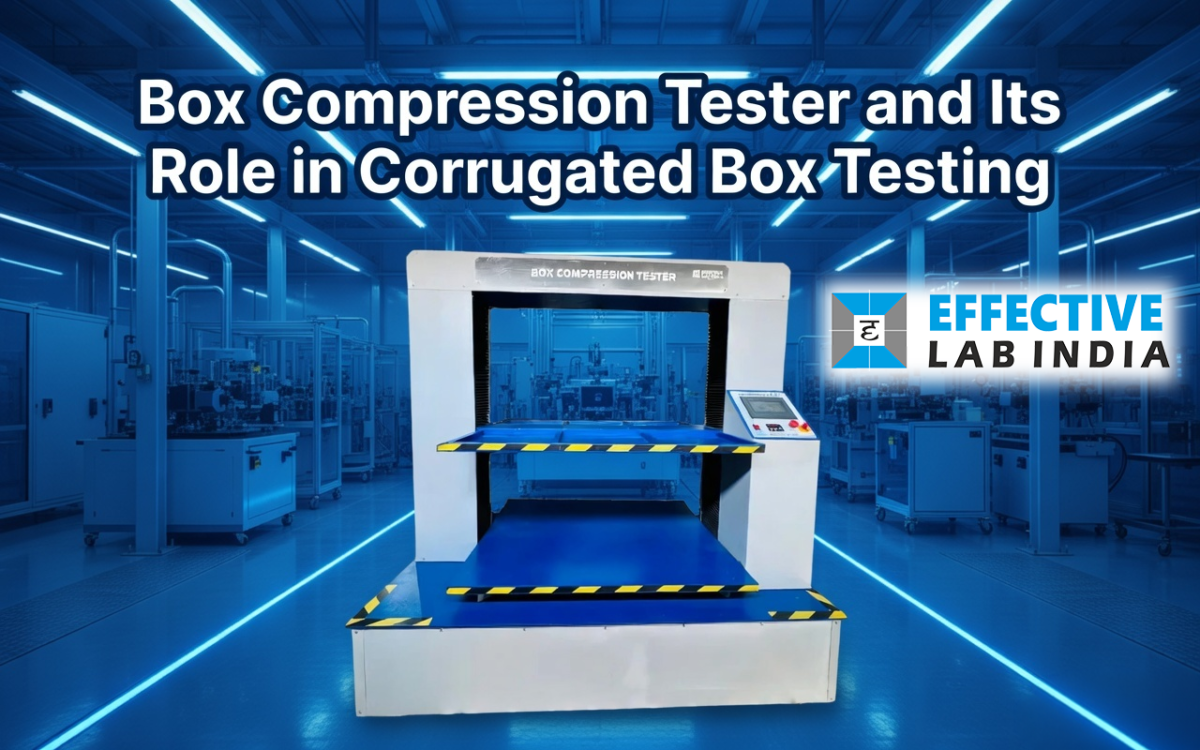
Box Compression Tester: Every single corrugated box that ends up on a warehouse shelf, in a retail store, or at the front door of a customer has traveled through a supply chain during which it was stacked and subjected to vibration and humidity — all of which stealthily degrade its strength. A box compression tester is the device that will let you know — in quantifiable, standards-compliant metrics — precisely how much load your box can support before it collapses.
The box compression test is one of the most important quality checks in the corrugated packaging industry. If you produce export cartons, e-commerce shippers, or industrial transit boxes, understanding how a box compression tester operates — and making use of box compression test strength BCT calculator logic to validate your designs — is critical for providing packaging that preserves products, reduces damage claims, and meets buyer specifications.
For decades, we have worked with packaging manufacturers, testing laboratories, and quality assurance teams to define reliable box compression testing workflows at Effective Lab India. It encompasses everything from the working principle of the instrument to the global standards that regulate it and tips for choosing an appropriate tester for your facility.
Why Box Compression Matters in Logistics and Storage
In a modern supply chain, however, a single shipment of corrugated boxes can be stacked as high as four to six pallet layers tall in some warehouses; transported hundreds of kilometers in dry trucks, and then stored wet for weeks in fulfillment centers. All of these events place cumulative compressive stress on the box. And if the box wall buckles, the contents of your product are compromised — and so is the brand delivering it.
Box compression is the amount of axial load a box can support along its vertical axis: the direction that gravity and stacking weight are exerted. This is not the bursting strength of the board or the puncture resistance of the liner; this only refers to structural rigidity under compression. BCT requirements for heavy goods such as beverages, hardware, and packaged foods can be hundreds of kilograms of force per box.
3 Critical Use Cases for Box Compression Data in Real Life
- Stacking pallets in ambient and cold-chain warehouses, where relative humidity speeds up the degradation of strength
- Export shipment container loading, with multi-layer stacking for 20–30 days at sea
- Also, the packaging needs to withstand multiple handling on store shelves and remain intact.
- E-commerce fulfillment, in which oversized voids and lightweight dunnage change load patterns
- Where BCT validation with documentation is required for the regulatory audit of pharmaceutical secondary packaging
In lieu of a reliable box compression tester, these decisions must be based on guesswork, historical assumption, or over-specified materials — all of which serve to either increase risk or inflate cost. A single test cycle, performed in under two minutes, can prevent a field failure that could cost the company thousands of damaged units and an expensive logistics claim.
Suggested Post:
Box Compression Tester Price List – Affordable Strength Testing Machines
Standards Used in Box Compression Testing (ASTM, ISO)
A box compression test is only as good as the standard upon which it is based. Then, factors such as sample conditioning, test speed, platen geometry, and the reporting of results have been defined by international and national standards to ensure that BCT data can be directly compared between labs, suppliers, and countries. Instruments at Effective Lab India are designed and calibrated to meet the following international standards.
Test standards for box compression testing
- ISO 12048: The reference international standard for filled transport package compression and stacking tests. Specifies test speed, platens’ flatness tolerances, and reporting requirements. Commonly used in Europe, Asia, and for export compliance
- ASTM D642: The American standard regarding compression, load, and related tests for shipping containers. Covers a broad range of packaging forms and specifies constant-rate-of-compression and constant-load test modes.
- TAPPI T804: Primarily for corrugated fiberboard containers in North American markets. A constitution is needed from suppliers, depending on major US retailers and Logistics Service Providers, as part of supplier qualification.
- IS 7028 (BIS) Factors For Box Compression Test.
- FEFCO No. 50, the standard used in EU packaging audits and retail supplier compliance programs from the European Federation of Corrugated Board Manufacturers.
This sample conditioning is an important and neglected process. All major standards specify that samples of corrugated boxes be preconditioned for at least 24 h prior to testing at 23 °C ± 1 °C and 50 % ± 2 % relative humidity. That omission leads to results that overstate real-world performance — often by 15 percent or more, up to as much as 25 percent — resulting in field failures even with laboratory sign-off.
BCT Calculator: How to Estimate Box Strength Accurately
The calculator for box compression testing strength BCT is a predictive tool (BCT = Box Compression Test) to predict the compression resistance of a box from board-level properties, primarily the ECT value and board caliper (thickness). This expression is known as the McKee equation and has long been considered the industry standard, used to calculate muscle mass for over 50 years.
McKee Formula — Predicting Box Compression Strength
- BCT = 5.874 × ECT × √(Caliper × Z)
- BCT — Box Compression Strength (N or lbf)
- ECT — Edge Crush Test value of the board (kN/m or lbf/in);
- Caliper — the thickness of the corrugated board (m / inches)
- Z — Box perimeter (m or inches), i.e., 2 × (length + width)
- The constant 5.874 is empirical — different coefficients apply for modified McKee variants depending on the flute type
The BCT calculator will not replace physical testing — it is a design-phase tool to allow engineers to screen board specifications before committing them to production runs. A planned BCT that doesn’t meet the minimum stacking load then progresses to a board redesign or changes in design before any prototypes are constructed. After finalizing the design, the box compression test is validated on a certified tester, which compares the estimated value with the actual sample.
BCT calculator outputs can be entered directly into our test management software by Effective Lab India customers alongside physical results for a complete design-to-validation audit trail. This is especially useful for exporters who need to document both predicted and measured BCT values in submissions for compliance with buyers or retailers.
Working Principle of a Box Compression Tester
An apparatus that allows for the simultaneous application of a uniform controlled compressive force to the top and bottom faces of a corrugated box is referred to as a box compression tester, typically utilizing two parallel platens. The lower platen is stationary; the upper platen descends at a constant, programmable speed. A precision load cell measures the applied force, and a displacement sensor monitors how much the platens move. The instrument measures the maximum force at which point, the box structure fails — aka the BCT value.
- Sample preparation: The box is closed and taped as it would be in its intended use. This is then conditioned to the desired atmospheric conditions (most commonly 23°C / 50% RH for a period of around 24 hours).
- Platen alignment: The lower platen center has a box. Upper platen lowered into light contact with the sample, no pre-load applied.
- Test Execution: The device exerts compressive load on the boxes at a defined rate (usually 10 mm/min according to ISO 12048) until failure of the box is observed.
- Peak force capture: The load cell measures continuous force. The value corresponding to the maximum force before the defined drop (showing structural failure) is recorded as the BCT value.
- Data output: Results are displayed on the instrument and exported to connected software for statistical analysis, report generation, and comparison against specification limits
Applications of the Box Compression Tester in Corrugated Box Testing
Box compression tester finds a wide range of applications along the value chain of corrugated packaging. Every application has its own frequency needs, sample types, and specification thresholds — but the fundamental instrument and test principle is the same.
Primary applications across industries
- Confirm the quality of incoming raw materials for liner and fluting papers; validation of finished board BCT before shipment to box converters
- Box converter and printer: Post-conversion quality audits to ensure that die-cutting, printing, and gluing processes have not compromised board strength below specification
- FMCG and beverage companies: Qualification of packaging for new SKUs; periodic lot acceptance testing to ensure supplier consistency
- Professional e-commerce and 3PL operators: Qualification of packaging across weight classes and fragility tiers; damage rate reduction programs
- Export / retail compliance: BCT values needed in documents for submission to international buyers, retailers, or certifying agencies during the packaging approval processes
- 3rd-Party Testing Labs: NABL Accredited Box Compression Test Service for Industry Doesn’t Have an In-House Testing Facility
Advantages of Employing Box Compression Testing
Having a systematic box compression testing program with a classroom bed tester and BCT calculator will provide measurable, quantifiable, cost-effective, and quality assurance performance improvements.
Manufacturers and quality teams discover key benefits
- Lower product damage claims: Certified BCT values ensure boxes are designed to bear the real stacking loads they experience, eliminating the primary cause of in-transit packaging failure
- Material cost optimization: right-sizing board specification with BCT data delivers an anti-over-engineering capability — most manufacturers find a 10–15% weight reduction is possible without impacting performance
- Supplier qualification and monitoring: More consistent BCT benchmarks help provide objective criteria for approving new board suppliers, as well as ongoing quality of delivery
- Regulatory and buyer compliance: Documented BCT test reports fulfill international retailer, government procurement, and export certification body requirements
- Accelerated NPD: BCT calculator + Physical testing workflow eliminates the need for multiple physical prototypes and thus significantly reduces packaging development cycles
- Lower insurance and logistics cost: after all, a lower damage rate directly lowers freight insurance premiums and reverse logistics expenses over time
At Effective Lab India, we manufacture our Box compression tester range to provide these benefits from day one after installation. Well-calibrated to a national standard, followed by official software for the operator and a field service network that ultimately stretches into all major industrial zones in India. If you are a small corrugated converter needing to test 10 samples per week, or you are an integrated packaging plant running in continuous production quality control, we offer it with solution set suited for your scale, standards, and budget.
The takeaway: Rigid box compression testing is a mandatory quality activity. This is the best single predictor of whether your packaging will protect its contents from the factory floor to the final customer. Investing in a calibrated, standard-compliant tester — and adding a validated box compression test strength BCT calculator to your design workflow — is one of the highest-return decisions you can make as a packaging manufacturer.
Frequently Asked Questions
What is a Box Compression test, and why is it important?
A box compression test measures the maximum vertical compressive force a corrugated box can endure before its walls buckle and collapse. It matters because corrugated boxes in real-world logistics are stacked, kept in humid places, and vibrated during transport — all of these things put compressive stress on them. Without an effective BCT value that has been validated, manufacturers cannot be assured their packaging will protect products the entire way through the supply chain. The resulting value measured (in Newt or kfg) is then compared to a required stacking load with a suitable safety factor (4–6≤ more than kN per stack leaf) to ensure compliance.
WHAT IS A BOX COMPRESSION TESTER?
A box compression tester applies a compressive load uniformly to the top and bottom faces of a corrugated box between two parallel, flat platens — one fixed and one motor-driven. The upper platen proceeds downward at a constant, programmable rate (usually 10 mm/min per ISO 12048). A precision load cell measures the applied load in real time, and the instrument records the peak value at which structural failure occurs. The maximum force per unit area is termed Box Compression Strength (BCT). Today’s digital testers automatically capture, display, and export this data, making it fast and repeatable as well as audit-ready.
How accurate is a BCT calculator? What is a BCT calculator used for?
A box compression test strength BCT calculator utilizes the McKee formula — BCT = 5.874 × ECT × √(Caliper × Z) — to estimate a box’s compression strength using its board’s Edge Crush Test (ECT) figure, board caliper (thickness), and box perimeter (Z). This is most helpful in the design stage to filter board specifications before producing actual prototypes. For ‘standard’ corrugated constructions, the McKee formula will generally predict BCT to within ±10–15% of measured values. It’s a design-phase estimation tool, not a replacement for physical testing on a calibrated instrument — but together the two methods form an end-to-end qualification workflow fast enough to help reduce the time it takes to get an assay running in the field.
Are you governed by ASTM or ISO when testing box compression?
ASTM and ISO standards are both widely adopted, so your market and buyer requirements will guide the choice. ISO 12048 is the main international standard and is demanded by most European and Asian buyers, as well as for export documentation. ASTM D642 is the North American market standard, and it’s commonly specified by US retailers and logistics providers. In North America, specifically for corrugated containers, TAPPI T804 is also used extensively. In India, domestic certification is governed under BIS IS 7028. So effectively, one instrument can support multiple market requirements, and as such, the box compression testers built by Effective Lab India are designed and calibrated for all these standards.
Does humidity influence the box compression test results?
By far the most important variable influencing corrugated box compression performance is humidity. A corrugated box can lose as much as 40% in Box Compression Test (BCT) performance compared to the test condition of 23°C / 50% RH for relative humidity levels greater than 85%. The cellulose fibers in the paper pull moisture from humid air and, as a result, soften the board, giving it little stiffness. For products that are stored in cold chain, coastal, or monsoon environments, Effective Lab India suggests testing samples under standard atmospheric conditions as well as elevated humidity and adding a humidity safety factor to the BCT specification to cover the performance seen in the field.