
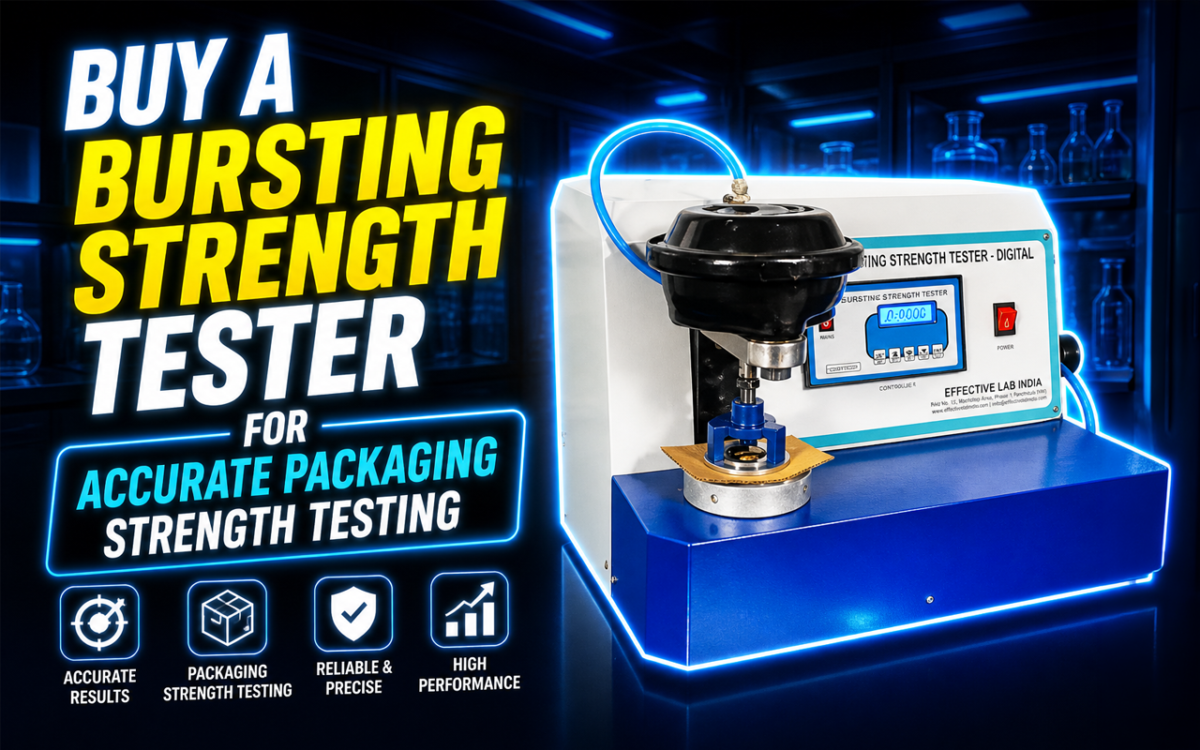
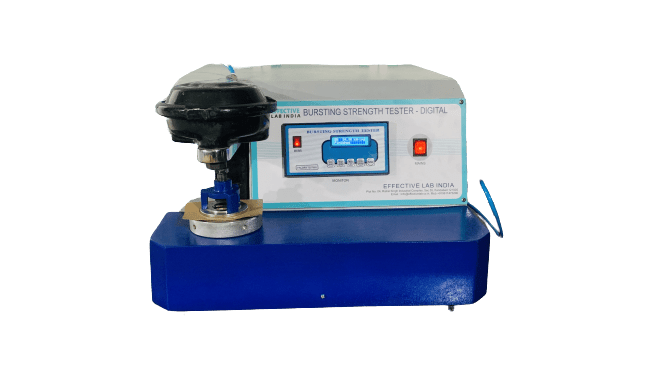
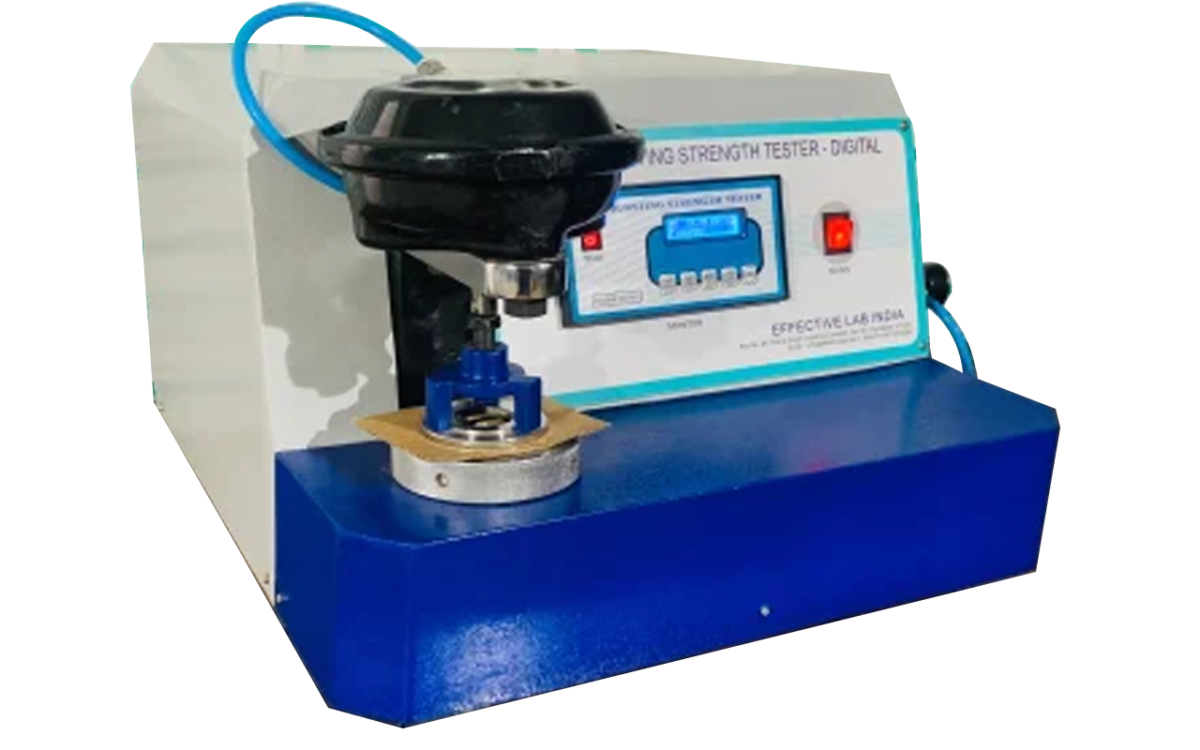
Bursting Strength Tester – Digital Pneumatic
Bursting Strength Tester is a reliable and accurate method used to measure the strength and durability of materials in various industries such as paper, paperboard, corrugated board, textile, leather, packaging, cardboard, paper bags and plastic films and other sheet materials to ensure safety. The material is placed within a special tester and tester continues applying pressure until the material bursts. This means that it checks the ability of the entire material to withstand the pressure before breaking or bursting. This test is very important for materials so that we can check their ability to withstand stress and pressure during handling and shipping.
Why is Important:
A Bursting Strength Tester is a precision laboratory instrument used to measure the maximum pressure a material can withstand before it ruptures or bursts. It is one of the most important quality control tools across industries that rely on sheet materials — including paper, paperboard, corrugated board, textiles, woven fabrics, leather, plastic films, and flexible packaging.
During the test, a specimen is clamped firmly between two circular clamps. Hydraulic or pneumatic pressure is then applied through a rubber diaphragm at a controlled, uniform rate until the specimen gives way. The pressure recorded at the point of burst is the material’s bursting strength, typically expressed in kg/cm² or kPa.
This single measurement tells engineers and quality teams a great deal about a material’s ability to survive real-world stresses — from the compression of a fully loaded shipping box to the internal pressure of an industrial woven sack. At Effective Lab India, our Digital Pneumatic Bursting Strength Tester is engineered to deliver accurate, repeatable results in compliance with leading international test standards, making it the preferred choice for quality laboratories across India and global markets.
Why Bursting Strength Testing Matters
Every material that is packaged, shipped, stored, or worn experiences mechanical stress. A cardboard box must bear the weight of stacked goods in a warehouse. A fabric airbag must withstand sudden pressure surges. A paper bag must hold its contents without splitting at the seam. Without a reliable way to measure bursting strength, manufacturers would have no objective basis for predicting whether their materials will perform or fail under those real conditions.
Here is why bursting strength testing is indispensable across industries:
Packaging Integrity Corrugated boxes, paper bags, and flexible packaging materials are routinely tested for bursting strength to confirm they can withstand the mechanical stresses of transport and storage. A burst test failure in the lab prevents a far costlier failure in the field — damaged goods, customer complaints, and brand damage.
Textile and Fabric Durability In the textile industry, bursting strength is a critical parameter for fabrics used in high-stress applications such as safety garments, parachute fabrics, geotextiles, airbags, and industrial filter bags. Tensile tests measure strength in one direction; bursting strength measures multidirectional resistance to pressure — a more realistic simulation of how fabrics perform in use.
Paper and Paperboard Quality Paper mills and converting facilities use bursting strength data to verify that paper and board grades meet the specifications required by printers, packagers, and end users. A higher burst factor indicates a stronger, more durable paper that will perform reliably in its intended application.
Regulatory and Customer Compliance Many industries have mandatory strength specifications written into procurement contracts, product standards, and shipping regulations. A bursting strength tester provides the documented evidence manufacturers need to demonstrate compliance and win customer confidence.
Product Development and Material Innovation Research and development teams use bursting strength data to compare materials, optimise formulations, evaluate new coating processes, and validate improvements before scaling up to production.
How the Bursting Strength Tester Works
The operating principle of Effective Lab India’s Digital Pneumatic Bursting Strength Tester is based on the Mullen Burst Test method, the internationally recognised standard for this type of testing. The process involves the following steps:
Step 1 — Sample Preparation Cut the test specimen to the required dimensions as specified by the applicable standard. Ensure the specimen is clean, flat, and free from visible defects, cuts, or moisture. Conditioning the sample in a standard atmosphere (23°C, 50% relative humidity) for at least 2 hours before testing is recommended for accurate, reproducible results.
Step 2 — Specimen Clamping Place the specimen centrally on the lower clamp of the tester. Activate the pneumatic clamping system, which applies a controlled, uniform clamping force around the perimeter of the specimen. This prevents the material from slipping during the test, which would produce erroneous results.
Step 3 — Pressure Application The machine automatically begins to inflate the rubber diaphragm beneath the specimen using glycerine (98% purity, lab grade) as the hydraulic test fluid. Pressure increases at a controlled rate of approximately 95 cc/minute until the specimen ruptures.
Step 4 — Burst Detection and Recording The moment the specimen bursts, the pressure sensor detects the sudden drop in pressure. The microprocessor-driven system records the peak pressure value and holds it on the LED display. The result is the bursting strength of the sample in kg/cm².
Step 5 — Data Analysis Results from multiple test readings (up to 9 readings stored in memory) are averaged to calculate the material’s mean bursting strength. From this, the burst factor can also be derived:
Burst Factor = Bursting Strength (gf/cm²) ÷ Grammage (gf/m²)
This figure is widely used in the paper industry to compare the strength of papers with different basis weights on a normalised basis.
Defend Your Products from Corrosion
A bursting strength tester for materials to ensure the durability and quality of the material under pressure
Why Need Bursting Strength Testers
Bursting strength is an important testing technique for all materials, testing the ability of materials such as paper, cardboard and clothing to withstand pressure before bursting or breaking. This Bursting Strength Tester is applicable for many industries such as packaging, paper and textile to ensure the durability and safety of their products during storage, handling and transportation. By applying these types of material testing techniques the tester helps manufacturers ensure quality standards, resistance of materials to pressure, prevent failures, and customer satisfaction.
Recent Post:
Xenon Test Chamber Applications in the Automotive Industries
Environmental Test Chambers: Salt Spray Chamber, Ozone Test Chamber & Xenon Arc Test Chamber
Importance of Using a Bursting Strength Tester
The Bursting Strength Tester is crucial for several reasons:
- Ensuring Product Quality: It helps verify the strength and durability of materials, ensuring they meet required specifications.
- Product Development: Essential for research and development, it aids in creating new materials and improving existing ones.
- Compliance: Ensures that materials and products comply with industry standards and regulations.
- Customer Satisfaction: By guaranteeing the quality and reliability of materials, it enhances overall customer satisfaction.
How to Use the Bursting Strength Tester
Using the Bursting Strength Tester is straightforward, ensuring even those new to the equipment can achieve accurate results. Follow these steps for optimal performance:
- Sample Preparation: Cut the material sample according to the required dimensions and ensure it is clean and free from defects.
- Loading the Sample: Place the sample securely in the tester’s clamp. Make sure it is centred and properly aligned.
- Setting Parameters: Input the necessary test parameters, such as the type of material and the testing speed.
- Initiating the Test: Start the machine to apply pressure to the sample. The machine will gradually increase the pressure until the sample bursts.
- Recording Results: The machine will automatically record the bursting strength of the material, which can then be analyzed for quality control purposes.
Test Standards Compliance
Effective Lab India’s Bursting Strength Tester complies with multifarious international test standards that explain its versatility and reliability across different industries. These standards include:
- ASTM D3786 – The Standard Testing Method is defined for Testing the Bursting Strength of Textiles / Fabrics, also known as the Diaphragm – Bursting Strength Test Method)
- ISO 2758 The Standard Testing Method is defined for Determination of Bursting Strength of Papers
- ASTM D774 – Standard Test Method for Bursting Strength of Paper
- TAPPI T403 – Bursting Strength of Paper
Why Choose Effective Lab India?
Effective Lab India is a leading manufacturer and exporter of laboratory testing instruments, headquartered in Faridabad, Haryana, India. We design, manufacture, and calibrate our instruments in-house, ensuring tight control over quality at every stage of production.
Our Bursting Strength Tester is built with industrial-grade components for long service life, and every unit is calibrated and validated before dispatch. Our technical support team provides installation assistance, operator training, and after-sales service to ensure your instrument performs to specification throughout its operational life.
Whether you operate a paper mill, a packaging plant, a textile testing lab, or a third-party quality testing facility, Effective Lab India has the right bursting strength testing solution for your needs.
Suggested Product:
Bench UV Light Accelerated Weathering Chamber
Box Compression Tester Manufacturer
Parameter Specification Testing Range 40 kg/cm² Least Count 0.1 kg/cm² Accuracy ±1% within 10%–90% of full range (as per IS: 1828) Specimen Clamping Pneumatic Pressure Sensor Pressure Transducer Test Fluid Glycerine, 98% purified (lab grade) Rate of Fluid Displacement 95 cc/minute Display LED Digital Readout Power Requirement 220V, 50 Hz AC, Single Phase Dimensions L 60 cm × W 55 cm × H 45 cm Net Weight 77 kg Gross Weight (Packed) 93 kg Applicable Standards ASTM D3786, ISO 2758, ISO 3303-1:2012, ISO 3689:1983, BS 3137, IS 1060:1987, IS 1828
Luminous LED Digital Display The bright LED readout delivers clear, easy-to-read test results in any laboratory lighting condition, eliminating the ambiguity associated with analogue gauge readings.
Pneumatic Specimen Clamping Automated pneumatic clamping removes the variability introduced by manual clamping, ensuring the specimen is held with consistent, repeatable force in every test. This is critical for maintaining measurement accuracy across operators and shifts.
Peak Hold Facility The peak hold function captures and retains the maximum pressure value at the moment of burst, even if the display is not observed at that precise instant. This ensures no test result is missed or misread.
Memory for Up to 9 Test Readings Operators can store up to 9 individual burst readings within a test session, enabling the calculation of average values directly from the instrument without manual note-taking.
Feather-Touch Controls Single push-button operation simplifies the testing process. The feather-touch control panel is intuitive enough for new operators to use immediately with minimal training.
Grooved Specimen Holder The test specimen holder features precision-machined grooves that grip the sample securely during testing, preventing any slippage that could affect the accuracy of the burst measurement.
Microprocessor-Driven Precision An onboard microprocessor manages all test parameters — pressure application rate, clamping force, peak capture, and display — delivering consistent, traceable results that meet the reproducibility requirements of international standards.
Adjustable Clamping Pressure The clamping pressure can be manually adjusted to accommodate different material types and thicknesses, giving the operator full control over test conditions while reducing measurement variability caused by inconsistent clamping.
The Effective Lab India Bursting Strength Tester serves a wide range of industries where material strength under pressure is a key quality parameter:
Paper and Pulp Industry Paper mills use the tester to evaluate writing paper, kraft paper, newsprint, tissue, and specialty papers against burst strength specifications required by converters and end users.
Corrugated Box and Paperboard Manufacturing Corrugated board manufacturers test finished boxes and liners to ensure they meet the burst strength requirements of Indian and international packaging standards such as IS 1060.
Textile Industry Woven and knitted fabrics — particularly those used in safety garments, industrial protective wear, geotextile applications, and filter fabrics — are evaluated for multidirectional strength using the diaphragm burst test method per ASTM D3786 and ISO 3303.
Flexible Packaging Manufacturers of laminated films, aluminium foil laminates, and multilayer pouches use burst testing to verify the structural integrity of the finished package under internal pressure conditions representative of filling, sealing, and distribution.
Leather Industry Leather used in footwear, belts, upholstery, and industrial applications is tested for burst strength to assess its resistance to perforation and multi-axial stress.
Nonwoven and Filter Media Nonwoven fabrics used in filtration, medical textiles, hygiene products, and protective clothing are evaluated for burst strength to ensure they maintain their structure under operational pressure differentials.
Quality Control Laboratories Third-party testing laboratories, government testing agencies, and accreditation bodies use the instrument to provide independent burst strength certification for materials across all the above sectors.
Effective Lab India's Bursting Strength Tester is designed and verified to comply with the following internationally recognised test standards:
- ASTM D3786 — Standard Test Method for Bursting Strength of Textiles — Diaphragm Bursting Strength Tester Method
- ASTM D774 — Standard Test Method for Bursting Strength of Paper
- ISO 2758 — Paper — Determination of Bursting Strength
- ISO 3303-1:2012 — Rubber- or Plastics-Coated Fabrics — Determination of Bursting Strength
- ISO 3689:1983 — Fibre Building Boards — Determination of Bursting Strength
- BS 3137 — British Standard for Determination of Bursting Strength of Fabrics
- IS 1060:1987 — Indian Standard for Corrugated Fibreboard Boxes
- IS 1828 — Indian Standard Method for Accuracy Specification (±1% within 10%–90% range)
- TAPPI T403 — Bursting Strength of Paper
Having a single instrument that covers this breadth of standards makes the Effective Lab India Bursting Strength Tester a highly versatile and cost-effective solution for multi-industry quality laboratories.
Know About Our Products
Effective Lab India is a highly specialized laboratory testing equipment used for measuring bursting strength. It is commonly used in various industries such as paper, cardboard, textiles and packaging to ensure the durability and quality of materials under pressure. Using this technology manufacturers keep your products safe for a long time and this technology is designed by international standards and meets the complete satisfaction of the customers and provides accurate and reliable test results every time.
Tensile strength measures a material's resistance to being pulled apart along a single axis — essentially how much force is needed to snap a strip of paper when pulled from both ends. Bursting strength, by contrast, measures the material's resistance to multidirectional pressure applied uniformly across its surface through an expanding rubber diaphragm. For packaging and flexible materials, bursting strength is generally considered a more practical and realistic indicator of performance, because the forces a box or bag experiences during handling, stacking, and transport act from multiple directions simultaneously. Both tests provide complementary data, and quality standards for paper and packaging materials typically specify minimum values for both.
For instruments used in routine production quality control, calibration is typically recommended every 12 months or whenever the instrument is relocated, serviced, or suspected of producing inconsistent results. Calibration involves verifying the accuracy of the pressure transducer and the rate of fluid displacement against traceable reference standards, checking the integrity and condition of the rubber diaphragm (which must be replaced when cracked, hardened, or deformed), confirming the pneumatic clamping pressure is within the specified range, and validating the display and peak-hold functions. Effective Lab India recommends calibrating the instrument in accordance with IS 1828 requirements, which specify accuracy within ±1% of full scale across 10%–90% of the measurement range. Our service team provides on-site calibration support on request.
Yes — Effective Lab India's Digital Pneumatic Bursting Strength Tester is a multi-standard instrument capable of testing both paper and textile specimens on the same machine. The applicable standard changes based on the material being tested: ISO 2758 and ASTM D774 govern paper testing, while ASTM D3786, ISO 3303-1, and BS 3137 govern textile testing. The test procedure and clamping conditions are the same for both material types; the key differences lie in the specimen preparation, pre-conditioning requirements, and the way results are reported and interpreted. Because the instrument operates across all these standards, a single unit can serve a multi-industry quality laboratory, eliminating the need to invest in separate instruments for paper and fabric burst testing.
The ASTM for bursting strength is ASTM D3786. The procedures and guidelines for bursting strength tests of textiles are provided by this standard.



Contact Form
Connect with us will help you with their queries...
For accurate laboratory testing results? contact us
for high-quality testing equipment solutions.