Hot Air Oven Price in India 2026:for Labs, Industrial & Commercial Use
June 2, 2026
Xenon Test Chamber Applications in the Automotive Industries
June 8, 2026
Environmental Test Chambers: Every product that leaves a factory floor faces one inevitable challenge: the real world. Heat, humidity, salt-laden air, ozone, and ultraviolet radiation relentlessly attack materials, coatings, and finished goods. Without rigorous environmental testing, manufacturers risk shipping products that fail prematurely — damaging their reputation, increasing warranty costs, and, in some industries, creating genuine safety hazards.
Environmental testing chambers allow manufacturers to simulate years of real-world exposure in a matter of days or weeks. By recreating harsh conditions under controlled laboratory settings, quality assurance teams can identify weaknesses early, refine materials, and validate products before they reach customers.
Effective Lab India is a trusted manufacturer of environmental test chambers in India, supplying precision testing instruments to industries ranging from automotive and aerospace to rubber, polymers, and packaging. With a focus on engineering accuracy, regulatory compliance, and responsive customer support, Effective Lab India helps manufacturers build products that last.
Understanding Environmental Testing Chambers
What Are Environmental Testing Chambers?
Environmental testing chambers are controlled laboratory instruments designed to expose test specimens to specific environmental conditions — such as salt mist, ozone concentrations, or simulated sunlight — to assess their durability, corrosion resistance, and weather performance.
These instruments are essential in quality assurance workflows because they accelerate aging processes. A product that might take years to degrade outdoors can show its vulnerabilities in days inside a properly configured chamber.
Industries That Rely on Environmental Testing
A wide range of industries depend on environmental testing equipment to maintain product quality and meet international standards:
- Automotive: Testing coatings, body panels, fasteners, seals, and electrical connectors for corrosion and UV resistance.
- Aerospace: Validating structural components, adhesives, and surface treatments against extreme environmental stress.
- Rubber and Polymers: Assessing ozone cracking, material degradation, and long-term elasticity in gaskets, seals, and hoses.
- Electronics and Electrical: Evaluating corrosion resistance of circuit boards, connectors, and enclosures.
- Packaging: Testing protective coatings and material durability for outdoor and industrial use.
- Construction and Building Materials: Verifying weather resistance of paints, coatings, sealants, and cladding materials.
- Marine Industry: Confirming corrosion protection for components exposed to saltwater environments.
Salt Spray Chamber: Testing Corrosion Resistance
What Is a Salt Spray Chamber?
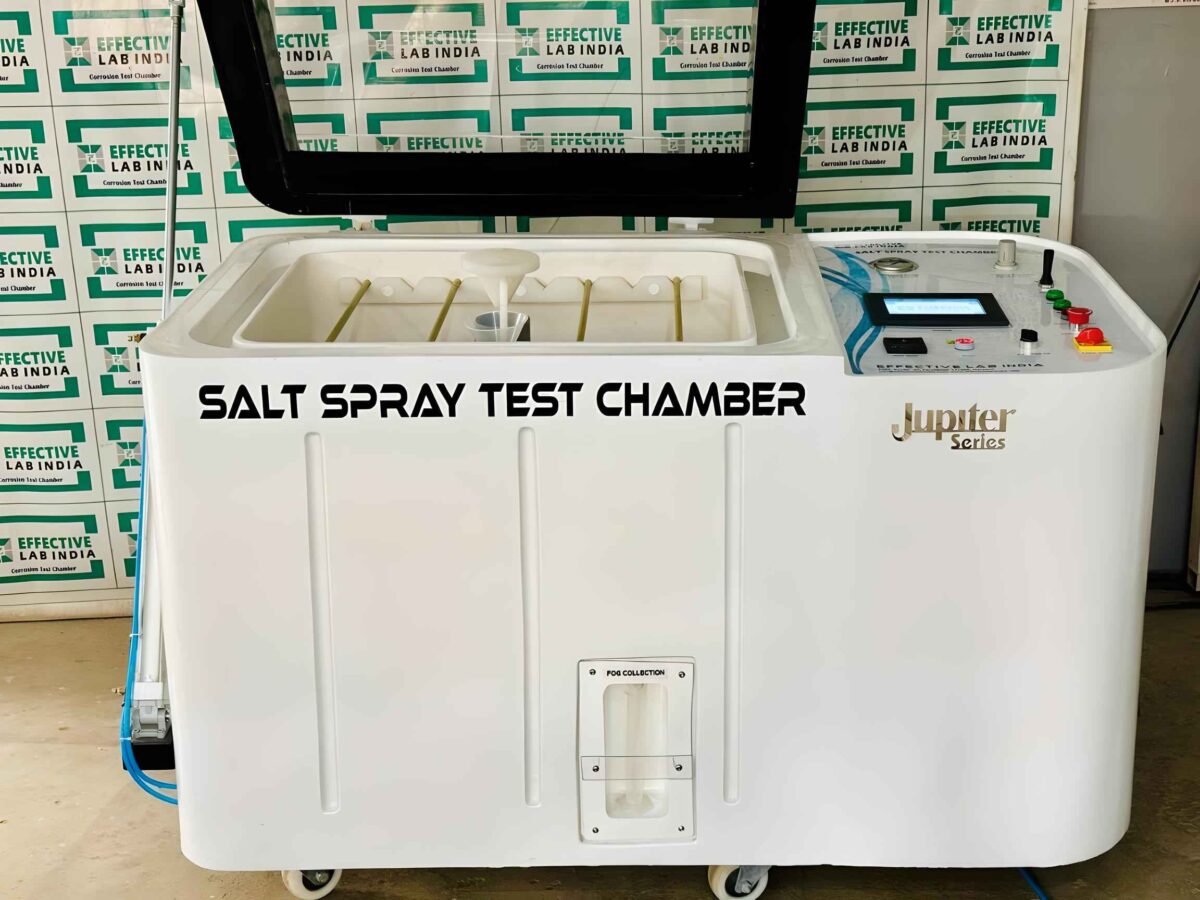
A Salt Spray Chamber — also referred to as a Salt Fog Chamber or Corrosion Test Chamber — is a laboratory instrument that creates a controlled saline mist environment to test the corrosion resistance of metals, coatings, paints, and surface treatments. It remains one of the most widely used accelerated corrosion testing methods in manufacturing.
How Does It Work?
The chamber atomises a sodium chloride (NaCl) solution into a fine, continuous fog that settles uniformly over test specimens. The temperature inside the chamber is maintained at a precise level — typically 35°C for standard testing — while the salt concentration, pH level, and fog density are carefully controlled. Specimens are held at a defined angle to ensure consistent exposure.
Test durations can range from a few hours to several thousand hours, depending on the applicable standard and the product being evaluated.
Key Features of Effective Lab India’s Salt Spray Chambers
Effective Lab India designs its Salt Spray Chambers to deliver consistent, reproducible results across extended test cycles. Key engineering features include:
- Precision temperature control with uniform distribution throughout the cabinet
- Automatic salt solution replenishment to maintain consistent fog density
- Corrosion-resistant cabinet construction (typically FRP or polypropylene) that withstands the aggressive saline atmosphere
- Programmable controllers for setting test duration, temperature, and other parameters
- Compliance with ASTM B117, ISO 9227, and other internationally recognised corrosion testing standards
Applications
Salt Spray Chambers are used to evaluate:
- Electroplated and galvanised coatings on metal components
- Automotive body parts, fasteners, and trim
- Marine hardware and deck fittings
- Industrial machinery and equipment
- Consumer electronics enclosures and connectors
- Protective coatings for structural steel
Benefits for Quality Assurance
By identifying corrosion vulnerability early in the product development cycle, manufacturers reduce costly field failures, streamline certification processes, and build buyer confidence. Salt spray testing also supports compliance with industry procurement standards, making it a non-negotiable step for many export-oriented manufacturers.
Ozone Test Chamber: Essential for Rubber and Polymer Testing
What Is an Ozone Test Chamber?
An Ozone Test Chamber is a laboratory instrument used to assess how rubber, elastomers, polymers, and related materials respond to elevated ozone concentrations. Ozone is a naturally occurring atmospheric oxidant, and even trace concentrations can cause cracking, surface degradation, and mechanical failure in rubber-based components over time.
Accelerated ozone testing compresses years of atmospheric exposure into a controlled test cycle, giving manufacturers reliable data to guide material selection and design decisions.
Working Principle
The chamber maintains a precisely defined ozone concentration — expressed in parts per hundred million (pphm) or parts per million (ppm) — at a controlled temperature and humidity level. Test specimens, often stretched to simulate real service stress, are placed inside and exposed for a specified duration. After testing, specimens are examined for cracking pattern, crack depth, and surface degradation.
The ozone is typically generated internally using a UV lamp or corona discharge system, and concentration is continuously monitored and adjusted to stay within the target range.
Industries Served
Ozone Test Chambers serve any industry that relies on rubber or elastomeric materials in its products or processes:
- Rubber component manufacturers producing seals, gaskets, O-rings, and hoses
- Automotive suppliers testing wiring insulation, door seals, weather strips, and tyres
- Cable and wire manufacturers are evaluating jacketing and insulation materials
- Footwear producers assessing sole and outsole longevity
- Medical device manufacturers are testing tubing, gloves, and instrument seals
Advantages of Ozone Testing
Ozone cracking can occur rapidly and unpredictably in the field. A garden hose, tyre sidewall, or automotive door seal that cracks in service creates immediate quality and safety concerns. Systematic ozone testing during product development allows engineers to compare material formulations, validate compounding changes, and demonstrate compliance with standards such as ISO 1431-1 and ASTM D1149.
Effective Lab India’s Ozone Test Chambers offer stable ozone generation, accurate concentration control, and uniform distribution within the test zone — ensuring that results are repeatable and reliable across different test batches.
Importance for Rubber and Polymer Manufacturers
For rubber compounders and polymer formulation teams, the Ozone Test Chamber is not simply a compliance instrument — it is a research and development tool. Comparing the ozone resistance of different antioxidant concentrations, polymer blends, or surface treatments requires precise, controllable test conditions. Effective Lab India’s chambers provide that level of control, making them a practical asset for both quality labs and R&D departments.
Xenon Arc Chamber: Simulating Sunlight and Accelerated Weathering
What Is a Xenon Arc Chamber?
A Xenon Arc Chamber is an accelerated weathering testing instrument that uses a xenon arc lamp to simulate the full spectrum of natural sunlight — including ultraviolet (UV), visible light, and infrared radiation — combined with controlled humidity and temperature cycling. It is the most realistic method available for simulating outdoor weathering conditions in a laboratory environment.
How Xenon Arc Testing Works
The xenon arc lamp produces a continuous, high-intensity spectrum closely matched to natural sunlight. Optical filters are used to refine the output and match specific exposure conditions, such as direct sunlight, sunlight through window glass, or shaded daylight, depending on the end-use environment.
During the test cycle, specimens are subjected to alternating light and dark phases, with moisture introduced through spray nozzles or elevated humidity to simulate dew, rain, and condensation. Temperature and irradiance levels are monitored and maintained throughout, ensuring that each test cycle is consistent and reproducible.
Applications
Xenon arc testing is relevant wherever materials or finished products are exposed to sunlight and outdoor conditions:
- Automotive exterior components: bumpers, dashboards, door panels, and roof coatings
- Architectural paints, stains, and protective coatings
- Plastics used in outdoor furniture, signage, and construction
- Textile, leather, and composite materials for outdoor use
- Packaging materials designed for outdoor display
- Photovoltaic panels and solar energy components
Benefits of Xenon Arc Testing
Because xenon arc exposure closely replicates natural sunlight, the results translate well to real-world performance predictions. This is a significant advantage over narrower UV-only tests, which may not fully capture the degradation modes caused by visible and near-infrared radiation.
Key benefits include:
- Colour fastness evaluation: Identifying fading, yellowing, or colour shift under simulated sunlight before products reach retail.
- Gloss and surface integrity assessment: Detecting chalking, cracking, blistering, or hazing in surface coatings and plastics.
- Material strength retention: Measuring changes in tensile strength, elongation, and impact resistance after weathering exposure.
- Regulatory compliance: Supporting certification to standards such as ISO 4892-2, ASTM G155, and SAE J2527.
Effective Lab India’s Xenon Arc Chambers are engineered to maintain stable irradiance, precise temperature and humidity control, and consistent specimen rotation — all critical factors for producing reliable, standard-compliant test data.
Why Choose Effective Lab India as Your Testing Equipment Partner
Manufacturing Expertise
Effective Lab India brings focused engineering expertise to the design and manufacture of environmental testing equipment. Each chamber is built with attention to the specific demands of accelerated testing — tight parameter tolerances, robust construction materials, and reliable automation that reduces operator variability.
Product Quality and Consistency
Quality assurance starts with the equipment itself. Effective Lab India’s testing chambers are designed to deliver consistent performance across thousands of test hours, using materials and components selected for durability in demanding laboratory environments. Each instrument undergoes quality checks before delivery.
Industry-Focused Solutions
Rather than offering generic laboratory equipment, Effective Lab India aligns its product portfolio with the practical needs of the industries it serves. Whether a customer requires a compact bench-top chamber for a quality control lab or a larger capacity unit for a production testing environment, Effective Lab India provides appropriately scaled solutions.
Customer Support and After-Sales Service
A testing chamber is a long-term investment. Effective Lab India supports customers through installation, operator training, calibration assistance, and ongoing technical service. Responsive after-sales support helps laboratories maintain instrument performance and minimise unplanned downtime.
Compliance and Reliability
Effective Lab India’s chambers are designed to support testing in accordance with recognised international standards — including ASTM, ISO, and SAE specifications — giving customers confidence that their test results will be accepted by customers, certification bodies, and regulatory authorities worldwide.
Suggested Product:
Bursting Strength Tester – Digital Pneumatic
Bench UV Light Accelerated Weathering Chamber
How Testing Chambers Improve Product Durability and Market Competitiveness
Corrosion Resistance Through Salt Spray Testing
Salt spray testing enables manufacturers to catch corrosion vulnerabilities in coatings and surface treatments before products reach the field. This directly reduces warranty claims, enables smarter material and process selection, and helps manufacturers meet customer specifications for corrosion performance.
Weather Resistance Through Ozone and Xenon Arc Testing
Ozone testing and xenon arc weathering testing give manufacturers a clear, quantified picture of how their products age when exposed to atmospheric ozone and natural sunlight. This data guides formulation decisions for rubber and polymer products, and helps manufacturers of coatings and plastics predict colour stability and surface integrity over time.
Extending Material Longevity
By systematically exposing materials to accelerated environmental stress, manufacturers can identify which formulations, processes, or surface treatments deliver the longest service life — and communicate that durability to customers with confidence.
Validating Products for Demanding Markets
For manufacturers supplying automotive OEMs, aerospace primes, or major industrial buyers, environmental test data is often a prerequisite for approval. Effective Lab India’s chambers help suppliers generate the test documentation required to enter and compete in these demanding markets.
Conclusion
Environmental testing is not a cost — it is an investment in product quality, brand reputation, and customer trust. Salt Spray Chambers, Ozone Test Chambers, and Xenon Arc Chambers each address a distinct but equally important dimension of environmental durability. Together, they give manufacturers comprehensive tools for validating that their products can withstand the conditions of real-world service.
Effective Lab India stands as a dependable environmental test chambers manufacturer in India, providing well-engineered, standard-compliant testing solutions to quality laboratories and manufacturing facilities across diverse industries. Whether you are establishing a new testing capability or upgrading an existing one, Effective Lab India offers the expertise, product range, and support to help you achieve your quality assurance goals.
Frequently Asked Questions
Q1. What is the purpose of a Salt Spray Chamber?
A Salt Spray Chamber is used to test the corrosion resistance of metal components, coatings, paints, and surface treatments by exposing them to a controlled saline mist. The results help manufacturers evaluate the protective performance of coatings, compare different surface treatment options, and confirm compliance with corrosion resistance standards such as ASTM B117 and ISO 9227. It is widely used in automotive, aerospace, marine, and industrial manufacturing sectors.
Q2. Why is an Ozone Test Chamber important for rubber testing?
Rubber and elastomeric materials are highly susceptible to ozone-induced cracking, which can cause premature failure in seals, gaskets, hoses, and tyres. An Ozone Test Chamber replicates elevated atmospheric ozone concentrations under controlled conditions, allowing manufacturers to assess material resistance to ozone degradation, compare different rubber compounds or antioxidant formulations, and validate products against standards such as ISO 1431-1 and ASTM D1149. This testing is particularly critical for components used in automotive, industrial, and medical applications where seal integrity is essential.
Q3. How does a Xenon Arc Chamber help manufacturers improve product quality?
A Xenon Arc Chamber simulates the full spectrum of natural sunlight — including UV, visible, and infrared radiation — combined with humidity cycling, to accelerate the weathering process in a controlled laboratory environment. This allows manufacturers of coatings, plastics, textiles, and automotive components to identify colour fading, surface chalking, gloss loss, and mechanical property changes before products are released to market. The data generated supports material selection decisions, formulation improvements, and compliance with international weathering standards, ultimately helping manufacturers deliver products with predictable, long-lasting outdoor performance.
Recent Post:
Ozone Exposure Chamber vs UV Weathering Test Chamber
Hot Air Oven Price in India 2026:for Labs, Industrial & Commercial Use
For More Information, please reach out to us.
Contact: +91 93554 43334
Email: info@effectivelabindia.com
LinkedIn: Effective Lab India