Rubber Testing Ozone Test Chamber : Specifications & Industry Trend
April 21, 2026
Leading Laboratory Equipment Suppliers Offering Advanced Testing Solutions
May 9, 2026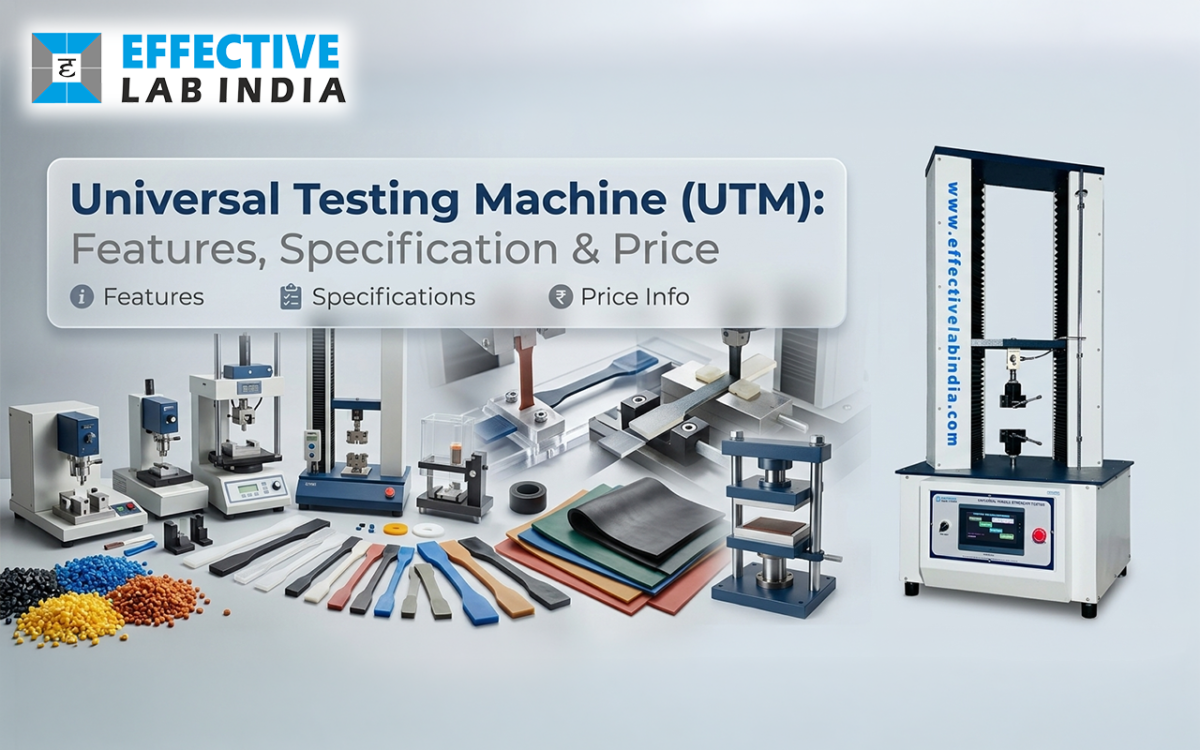
Universal Testing Machine (UTM): Materials testing is fundamental to engineering, manufacturing, and quality control in nearly all industrial sectors. When formulating a new polymer formula, qualifying your steel vendor, qualifying a rubber compound, or determining the peel strength of a laminated film, the one piece of equipment that is indispensable in your laboratory is the Universal Testing Machine.
It is also referred to with the acronym UTM, the universal testing machine is made for performing a wide range of mechanical tests, such as tensile testing, compression testing, flexure testing, shear testing, peel testing, and many others, from just one machine – a universal testing machine.
Effective Lab India is an industry leader in manufacturing high-precision instruments such as CASS CUM Salt Spray Chamber, Ozone Test Chamber, Cyclic Corrosion Test Chamber, UV Weathering Chamber, Box Compression Tester, and Bursting Strength Tester, among others. This guide presents all you need to know about the universal testing machines specification and features, industrial application areas, pricing, and selection process.
Universal Testing Machine: Overview, Working Principle & Key Industrial Uses
What is a Universal Testing Machine?
Universal Testing Machine is a mechanical testing device that can apply loads like tension (stretch), compression (compress), flexure (bend), shear, and peel on many different materials. “The word universal relates to the ability of the universal testing machine to conduct various tests on different materials such as metals, plastic, rubber, composites, textiles, adhesives, wood, foam, and paper using one single machine with different fixtures and grips”.
In UTM, load is applied by moving the crosshead with the help of a motorized device, which is either operated by a servomotor or a hydraulic system. A load cell senses the load applied by the universal testing machine. The force-displacement curve obtained with the UTM gives us full information regarding the mechanical behavior of materials.
Working Principle of a Universal Testing Machine
The working mechanism of the universal testing machine is very simple. A sample is clamped or held between two plates or fixtures, and a known and measured force is exerted on the material at a particular programmed rate. If it is a tension test, then the crosshead will move up, putting tensile force on the sample and breaking it apart.
If the test being conducted is compression, then the crosshead moves down, putting pressure on the sample and breaking it between two plates. In bending tests, whether three-point or four-point, the sample is kept between two supports, and a loading nose puts force on the middle point. Load cells and the extensometer (or crosshead encoder) keep recording force and deformation measurements, allowing the computer to analyze mechanical properties.
Types of Universal Testing Machines
- Electromechanical Universal Testing Machine: Operated by a servo motor coupled with a lead screw or ball screw system. Provides accurate speed regulation, high repeatability, and minimal noise. Suitable for conducting tensile, compressive, flexural, peeling, and shear tests on materials with forces ranging from 1 kN to 600 kN. Most commonly used type in industrial laboratories and research centers.
- Hydraulic Universal Testing Machine: Equipped with a hydraulic actuator that can generate extremely high loads ranging from 200 kN to 3,000 kN and even higher. Used in testing thick sections of structural steels, concrete samples, and large-sized bolts and nuts. Popular in civil engineering and structural materials testing laboratories, as well as heavy industries.
- Single-Column Universal Testing Machine: Bench-top machine model suitable for testing at light forces up to 5 kN. Perfect for testing films, foils, adhesives, medical devices, miniature plastic parts, and electronic connectors. Commonly used in packaging, medical devices, and electronics quality assurance laboratories, where bench space is limited.
Key Industrial Uses of the Universal Testing Machine
- METALS & ALLOYS – Tensile Strength, Yield Strength, Elongation & Reduction in Area tests of samples made of Steel, Aluminium, Copper & Titanium in accordance with ASTM E8/E8M & ISO 6892-1.
- PLASTICS & POLYMERS – Tensile, Flexural & Compressive test for thermoplastics and Thermosets according to ASTM D638, ASTM D790, ISO 527 & ISO 178.
- RUBBER & ELASTOMERS – Tensile Strength, Elongation at break, Modulus at specified elongation, and Tear resistance test in accordance with ASTM D412 & ISO 37.
- FIBRE FABRICS & GEOTEXTILES – Grab & Strip Tensile, Seam strength, Elongation Tests as per ASTM D5034, ASTM D5035 & ISO 13934.
- ADHESIVES & SEALANTS – Peel Strength Test of Adhesives using 90 degrees Peel test, 180 degrees peel test, T-Peel & Lap shear test as per ASTM D903, D1002 & ISO 11339.
- PAPER & PAPERBOARD – Tensile strength, Stiffness & Tear Resistance Tests for paper, paperboard & Flexible packing as per TAPPI & ISO Standards.
- COMPOSITES & ADVANCED MATERIALS – Inter
Universal Tensile Testing Machine: Features, Tensile Strength Testing & Applications
Core Technical Specifications of a Universal Tensile Testing Machine
An efficient universal tensile tester by Effective Lab India is equipped with the following technical specifications:
- Load cell capacity – 1 kN, 5 kN, 10 kN, 50 kN, 100 kN, 200 kN, 600 kN – depending on material and application
- Accuracy of Load Measurement – ±0.5% of the indicated load (Class 0.5 in accordance with ISO 7500-1)
- Crosshead Speed Range – from 0.001 mm/min up to 500 mm/min (programmed speed)
- Crosshead Travel – up to 1,200 mm (depends on model)
- Control System – closed loop system with PID servo motor for control of speed and force
- Extensometer – clip-on contact or non-contact video extensometer for measurement of deformation
- Measurement System – PC software with graph generation, multiple measurements calculations, and results report
- Material Handling Devices – interchangeable, wedge grips, pneumatic grips, compression platens, flexure fixture, peel fixture
- Results export – Excel, PDF, CSV formats, LIMS compatible
- Certification – ISO 7500-1, ASTM E4, ASTM E8/E8M, ISO 6892-1, ASTM D638, ISO 527, ASTM D412, ISO 37, and more.
Advanced Features of Effective Lab India’s Universal Tensile Testing Machine
Closed-Loop Servo Control System: We have incorporated in our tensile testers a closed loop servo control which constantly compares the current position of the crosshead with the desired position and takes necessary actions. This helps to ensure that the test procedure is done at a predetermined constant rate throughout the entire process of the test. This plays an important role in ensuring that the results are accurate and reliable in accordance with ASTM/ISO standards.
Multitest Software: This advanced software package comes built into our universal tensile tester and allows for tensile, compression, flexural, peel, shearing, and fatigue testing, among others. Users can also be able to customize test procedures, establish their own acceptance criteria, store their tests, and produce branded reports automatically on completion of the test procedure.
Automatic Limit Protection: Load/strain/displacement limit protection helps prevent any further movement after a certain predetermined point. It protects the load cell and the specimen from getting damaged due to overloading.
Price of Universal Testing Machine in India: The cost of a universal testing machine in India depends greatly on the load capacity, driving system, software features, type of extensometer, and compliance level.
Single-column electromechanical machines with capacities of 1 kN to 5 kN start from around INR 1,50,000 and go up to INR 3,00,000. Dual-column machines with capacities ranging from 10 kN to 100 kN, along with full software cost around INR 3,00,000 to INR 8,00,000. Machines with higher load capacities, starting from 200 kN to 600 kN, electromechanical or hydraulic universal testing machines up to 3,000 kN can be priced anywhere from INR 8,00,000 to INR 30,00,000 and above.
Suggested Post:
Rubber Testing Ozone Test Chamber: Specifications & Industry Trend
BOD Incubator: Understanding The Complete Diagram Every Lab Student Needs
Universal Test Machine: Choosing the Right Model for Your Testing Needs
How to Select the Right Universal Test Machine
Choosing the correct universal testing machine starts with a detailed assessment of your needs. The first and foremost requirement is the force capacity. It is important that the force capacity of the selected machine be greater by 20-30% compared to the largest expected failure load of the heaviest specimen. Testing closer to the maximum of the force sensor’s range reduces accuracy and can even cause sensor damage. On the other hand, overloading the machine when it is being used for testing specimens with small force values decreases precision and lowers accuracy. The Technical Team of Effective Lab India offers free consultancy in determining the appropriate force sensor capacity for your specimens.
The next important factor to consider is the type of testing you will be doing. If the majority of your testing involves performing tensile tests on metal and plastic samples, then an electromechanical universal testing machine with wedge grips and a clip-on extensometer would work fine for you. On the other hand, if your needs are for testing flexible packaging films, adhesive tapes, or even medical-grade elastomers, then you would have to choose a low-capacity machine equipped with a film grip set, a peel fixture, and a video extensometer.
Fixtures and grips may be undervalued, but they play an equally crucial role as the machine itself. Inappropriate use of the grip design, such as applying flat face grips to a circular sample or inadequate gripping force on a strong metallic sample, will lead to sample slippage and early failure in the grip region, rendering the test data unreliable. Effective Lab India offers a wide selection of grips and fixtures, customized according to application requirements, and our application experts will guide you in selecting the right fixture set for your sample.
Why Choose Effective Lab India as Your Universal Testing Machine Manufacturer
Precision Engineering at Lab India extends from our CASS CUM Salt Spray Chamber, Ozone Test Chamber, and Cyclic Corrosion Chamber lines to include all universal testing machines produced by us. All UTMs from us pass through extensive testing and certification, with a calibration certificate from NABL included in each shipment. Our universal test machines are constructed using robust steel structures, precision-machined crossheads, and heavy-duty servo systems that provide reliable service for years under tough industrial laboratory conditions.
Through our nationwide network of services, your laboratory is assured of installation, commissioning, operator training, periodic calibration, and preventive maintenance, irrespective of its location. To the various research institutes, NABL-approved testing laboratories, and larger industrial manufacturing units, our company provides custom-made service agreements and preferential technical assistance. Depending on whether you are looking for a small single-column universal tensile testing machine or a heavy-duty hydraulic universal test machine, Effective Lab India has something that fits your requirements at affordable prices. For more information, get in touch with our sales executives and have a detailed look at our product range through our comprehensive product catalogue and quotation.
Frequently Asked Questions (FAQs)
Q1. What is a Universal Testing Machine (UTM) and what tests can it perform?
Definition of Universal Testing Machine (UTM): A Universal Testing Machine (UTM) is an accurate testing equipment used in laboratory applications for determining the mechanical behavior of different materials by subjecting them to various loads such as tensile load, compressive load, flexural load, shear load, and peel load. The UTM is considered universal since it can be used to test a wide range of materials, including metals, plastics, rubber, textiles, composites, adhesives, paper, and foam, through just one machine equipped with different types of gripping devices.
Q2. What is the difference between an electromechanical and a hydraulic universal testing machine?
In the case of an electromechanical universal testing machine, the force application is achieved by means of a servo motor and screw mechanism used to raise the crosshead. This machine features speed control accuracy, low noise level, and high repeatability. It is manufactured in capacities up to 600 kN. The hydraulic universal testing machine uses a hydraulic actuator to apply the force and can produce considerably higher forces, starting from 200 kN and extending upwards to 3,000 kN. In laboratory tests on structural materials, it is preferable because of its ability to withstand very high forces.
Q3. What is the price of a Universal Testing Machine in India?
The cost of a Universal Testing Machine in India depends on various factors such as capacity, drive system (electromechanical or hydraulic drive system), software requirements, type of extensometer, and certificates of compliance. As a thumb rule: the cost of single-column universal testing machines (1-5kN) ranges from INR 1,50,000 to INR 3,00,000, the cost of mid-range double column universal testing machines (10-100kN) lies between INR 3,00,000 and INR 8,00,000, and the cost of higher capacity UTMs (200-600kN electromechanical or Hydraulic UTMs) is around INR 8,00,000-INR 30,00,000 and above.
Q4. Which international standards do Universal Testing Machines need to comply with?
Universal testing machines must comply with machine calibration and verification standards, including ISO 7500-1 (Verification of static uniaxial testing machines) and ASTM E4 (Force verification of testing machines). The specific material test standards depend on the material being tested: ASTM E8/E8M and ISO 6892-1 for metals tensile testing; ASTM D638 and ISO 527 for plastics; ASTM D412 and ISO 37 for rubber; ASTM D5034 and ISO 13934 for textiles; and ASTM D790 and ISO 178 for flexural testing. Effective Lab India’s universal testing machines are validated to comply with all of these internationally recognized standards.
Q5. Does Effective Lab India provide after-sales support and calibration for Universal Testing Machines?
Yes. Effective Lab India offers full after-sales services for all the universal testing machines provided by us, including installation, commissioning, training, NABL traceable calibration certificate at the time of delivery, periodic calibration services, preventive maintenance visits, provision of genuine spares, and technical help desk support. We have a nationwide service team with our application engineers deployed in key industries across India. If you need any guaranteed service times and preferential treatment, we can tailor our Annual Maintenance Contracts (AMC) for you. Our after-sales services philosophy is uniform for all products sold by us, whether Universal Test Machines, CASS CUM Salt Spray Chambers, or Ozone Test Chambers.
Get in touch with Effective Lab India for their full suite of test labs catered to your sector.
Contact: (+91) 9555515525
Email: info@effectivelabindia.com
WhatsApp: Effective Lab India