
Environmental Test Chambers: Salt Spray Chamber, Ozone Test Chamber & Xenon Arc Test Chamber
June 5, 2026
Salt Spray Test Chamber Manufacturers: Quality, Price, and Performance
June 11, 2026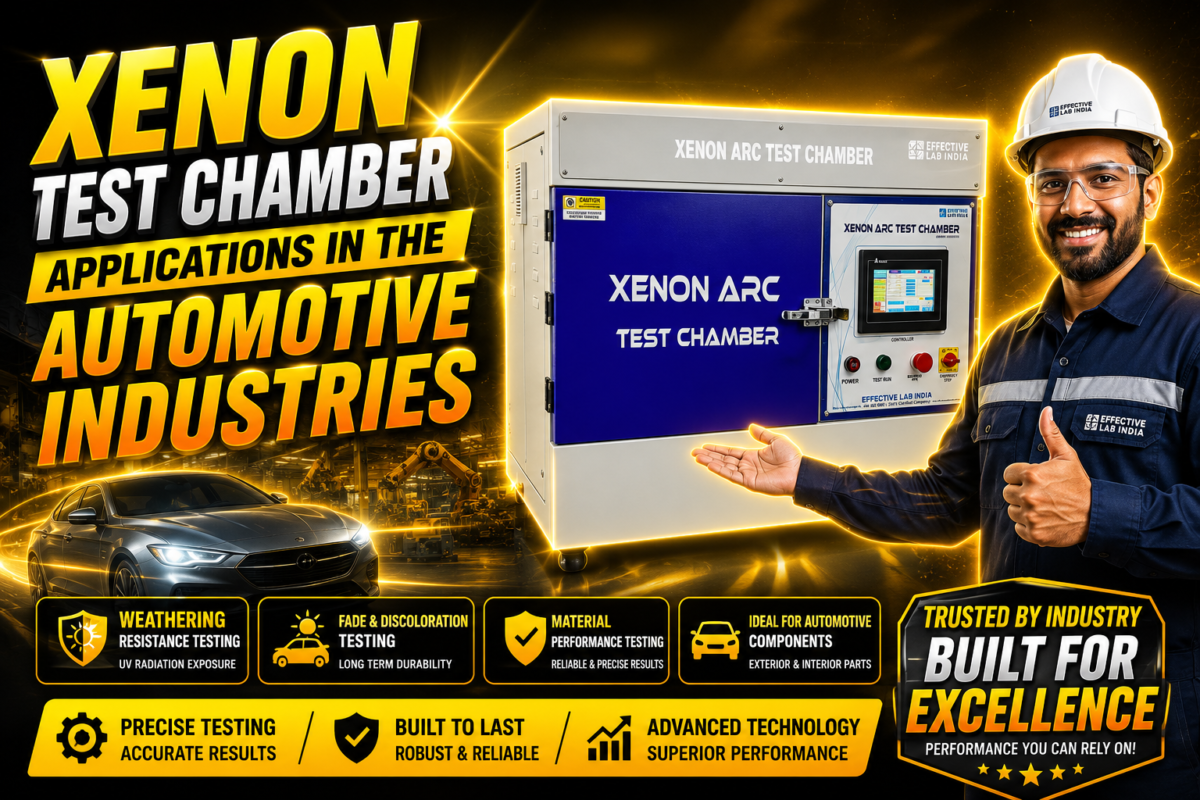
Xenon Test Chamber: Every vehicle that rolls off an assembly line faces a relentless enemy: time and the environment. Sun, rain, heat, humidity, and atmospheric pollutants work together to degrade materials, fade colors, and compromise structural integrity. Automotive manufacturers must ensure their vehicles can withstand years—sometimes decades—of this punishment before a single unit reaches a customer. This is where the xenon test chamber becomes indispensable.
A xenon test chamber is a controlled laboratory instrument that replicates the full spectrum of solar radiation, combined with programmable moisture and temperature cycles, to simulate real-world weathering conditions in an accelerated timeframe. Instead of waiting years for a material to degrade naturally, engineers can evaluate performance within days or weeks.
Accelerated weathering testing is not simply a regulatory box to check. It is a cornerstone of modern automotive engineering, enabling manufacturers to validate materials, predict service life, and eliminate failure points long before mass production begins. As vehicles become more sophisticated—incorporating advanced polymers, specialty coatings, and complex composites—the demand for reliable, repeatable weathering data has never been greater.
Why Automotive Manufacturers Use Xenon Test Chambers
Automotive manufacturers operate under extraordinary pressure. They must balance aggressive development timelines with strict quality requirements, all while managing the cost implications of warranty claims and product recalls.
Durability testing with a xenon weathering chamber directly addresses these pressures. By exposing materials to thousands of hours of simulated solar radiation during the design phase, engineers identify weaknesses before they become expensive field failures.
The quality assurance benefits are equally compelling. A xenon arc test chamber produces repeatable, standardized test conditions that allow engineers to compare materials, suppliers, and formulations with confidence. This consistency is impossible to achieve with outdoor exposure testing alone, where variability in weather, geography, and season introduces significant uncertainty.
From a cost perspective, the calculus is straightforward. Catching a coating formulation defect in the laboratory costs a fraction of what a mass recall would cost. Reduced warranty claims, stronger customer satisfaction scores, and a reputation for long-lasting vehicles all flow directly from rigorous accelerated weathering testing practices.
Role of Xenon Arc Lamp Technology in Weathering Testing
How a Xenon Arc Lamp Simulates Natural Sunlight
The xenon arc lamp is the technological heart of any xenon weathering chamber. What distinguishes it from other light sources—such as fluorescent UV lamps or metal halide lamps—is its ability to produce a continuous, broad-spectrum output that closely mirrors the solar spectrum.
Natural sunlight contains ultraviolet (UV) radiation, visible light, and infrared (IR) radiation across a continuous wavelength range. The xenon arc lamp generates light across all three regions simultaneously. When filtered correctly, it produces an output that matches the intensity and spectral distribution of sunlight reaching the Earth’s surface at sea level.
This full-spectrum simulation is critical for automotive material testing because different degradation mechanisms are triggered by different wavelengths. UV radiation drives photochemical reactions, causing polymer chains to break down, pigments to fade, and coatings to crack. Visible and infrared energy contribute to thermal loading, accelerating oxidative degradation. A light source that replicates all three simultaneously produces test results that genuinely reflect real-world performance.
Suggest Post:
Ozone Exposure Chamber vs UV Weathering Test Chamber
How Cyclic Corrosion Chambers Simulate Real Environmental Conditions
Leading Laboratory Equipment Suppliers Offering Advanced Testing Solutions
Benefits of Xenon Arc Lamp-Based Testing for Automotive Components
The advantages of xenon arc lamp-based testing extend well beyond spectral accuracy.
Faster product validation is perhaps the most operationally significant benefit. A well-designed xenon weathering chamber can compress years of outdoor exposure into weeks of laboratory testing, dramatically compressing development cycles.
Accurate weather resistance evaluation is another major advantage. Because the test conditions are precisely controlled and fully documented, the results are directly comparable across tests, facilities, and even continents. This consistency enables global automotive manufacturers to align their quality standards across supply chains.
Finally, xenon arc testing enables improved material performance prediction. Engineers can model how a material will behave after five, ten, or fifteen years of field exposure—providing the data needed to make informed decisions about material selection, coating formulations, and component design.
Applications of Xenon Arc Test Chamber in the Automotive Industry
Exterior Paint and Coating Durability Testing
Automotive paint systems are engineered to be both functional and aesthetic. They protect the vehicle body from corrosion while delivering the visual appeal that influences purchasing decisions.
A xenon arc test chamber subjects paint panels to intense UV radiation, elevated temperatures, and moisture cycles that simulate years of sun and rain exposure. Engineers measure color shift using spectrophotometers, track gloss retention over thousands of hours, and evaluate adhesion, blistering, and delamination. This data allows coatings chemists to fine-tune formulations and ensure the finished vehicle maintains its appearance throughout its expected service life.
Dashboard and Interior Material Aging Tests
Vehicle interiors present a particularly demanding weathering challenge. Dashboard surfaces, instrument panels, door trims, and center consoles are exposed to direct sunlight through the windshield and side glass—sometimes reaching surface temperatures exceeding 100°C.
Under these conditions, plastics and composite materials can undergo UV-induced degradation: fading, chalking, cracking, and embrittlement. A xenon test chamber replicates these conditions with precision, allowing interior designers and materials engineers to select polymers and surface treatments that maintain their appearance and structural integrity over the vehicle’s lifetime.
Plastic and Polymer Component Evaluation
Modern vehicles incorporate plastics throughout their construction—from exterior body panels and bumpers to under-hood components and structural reinforcements. Each of these components must demonstrate long-term resistance to solar degradation.
Xenon weathering testing evaluates structural integrity loss, surface discoloration, impact resistance reduction, and dimensional stability changes in plastic and polymer parts. The results guide materials selection and additive formulation, ensuring that components perform reliably even after extended outdoor exposure.
Rubber Seal and Gasket Weather Resistance Testing
Rubber seals, gaskets, and weatherstripping serve critical functions—keeping water, wind noise, and debris outside the passenger compartment. Their performance depends on maintaining flexibility and elasticity across a wide temperature range over many years.
UV radiation is particularly damaging to rubber compounds, promoting surface cracking, hardening, and loss of sealing effectiveness. A xenon weathering chamber evaluates flexibility retention, crack resistance, and the environmental durability of rubber components, helping manufacturers select compounds that maintain their sealing performance throughout the vehicle’s service life.
Automotive Components Commonly Tested in a Xenon Arc Test Chamber
Automotive Paints
Why testing is necessary: Paint systems are the vehicle’s primary visual and protective surface layer. Failure is immediately visible and directly damages brand perception.
Common failure modes: Gloss reduction, color fading (particularly reds and blues), chalking, delamination, and corrosion breakthrough at paint defects.
Benefits of xenon weathering testing: Enables rapid comparison of competing formulations, verification of supplier claims, and validation against global OEM specifications—all before committing to production.
Plastic Trims
Why testing is necessary: Exterior trim components must maintain their appearance and dimensional stability across decades of UV exposure and thermal cycling.
Common failure modes: Color fading, surface chalking, embrittlement, warping, and loss of surface texture.
Benefits of xenon weathering testing: Accelerated screening allows engineers to identify underperforming materials early in the design cycle, reducing the risk of field failures.
Rubber Parts
Why testing is necessary: Door, hood, and trunk seals must remain flexible and resilient throughout the vehicle’s service life.
Common failure modes: Surface cracking (ozone and UV-induced), hardening, loss of compression set recovery, and adhesion failure at bonded interfaces.
Benefits of xenon weathering testing: Validates rubber compound selection and the effectiveness of surface treatments under realistic combined UV, heat, and moisture conditions.
Headlamp Lenses
Why testing is necessary: Polycarbonate headlamp lenses are exposed to intense UV radiation and elevated temperatures throughout their service life. Yellowing and hazing directly impair light output and driving safety.
Common failure modes: UV-induced yellowing, surface hazing, microcracking, and coating delamination.
Benefits of xenon weathering testing: Enables evaluation of UV-stabilizer effectiveness and hard coating performance, ensuring lenses maintain optical clarity over time.
Interior Panels
Why testing is necessary: Interior panels are subject to intense solar loading through glazing. Their appearance directly influences customer satisfaction and perceived vehicle quality.
Common failure modes: Color fading, surface gloss change, tactile surface degradation, and embrittlement of thin cross-sections.
Benefits of xenon weathering testing: Provides data to validate colorant systems, surface textures, and polymer stabilizer packages for long-term aesthetic performance.
Upholstery Materials
Why testing is necessary: Seat fabrics, leather, and synthetic leatherette materials are highly visible surfaces that customers evaluate on a daily basis.
Common failure modes: Color fading, surface pilling, structural degradation of fibers, and delamination of multi-layer constructions.
Benefits of xenon weathering testing: Allows textile and material engineers to compare dye systems, surface treatments, and substrate constructions under accelerated but realistic solar exposure conditions.
How Xenon Test Chambers Help Improve Vehicle Quality and Lifespan
The contribution of xenon weathering testing to vehicle quality extends far beyond individual component performance.
At the system level, validated materials and coatings translate directly into vehicles that look better, perform better, and last longer. Consumers increasingly expect vehicles to maintain their appearance for ten years or more. Manufacturers who can deliver on that expectation build stronger brand loyalty and command higher residual values.
From a warranty perspective, every failure mode eliminated through laboratory testing represents a real reduction in warranty costs. The financial impact of identifying a material deficiency in the lab rather than in the field can be measured in millions of dollars across a production run.
Ultimately, the most important outcome of rigorous accelerated weathering testing is customer satisfaction. A vehicle that looks as good at year eight as it did at year one earns the kind of word-of-mouth advocacy that no advertising campaign can replicate.
Industry Standards Supported by Xenon Test Chambers
ASTM Testing Standards
The American Society for Testing and Materials (ASTM) publishes widely adopted standards for accelerated weathering. Two of the most relevant for automotive applications are:
- ASTM G155: Specifies the practice for operating xenon arc light apparatus for exposure of non-metallic materials. It defines irradiance levels, filter types, moisture programs, and test cycle specifications used across automotive and industrial applications.
- ASTM D2565: Covers practice for xenon arc exposure of plastics intended for outdoor applications, including automotive exterior components. It addresses spectral power distribution, test cycles, and specimen evaluation criteria.
ISO Weathering Test Standards
The International Organization for Standardization provides globally harmonized weathering test methods recognized by automotive manufacturers worldwide:
- ISO 4892-2: Specifies methods for the exposure of plastics to xenon arc lamp light sources. It is widely referenced in European automotive specifications and addresses both equipment requirements and test procedure variables.
SAE Automotive Material Testing Standards
The Society of Automotive Engineers (SAE) publishes automotive-specific weathering standards that are directly incorporated into OEM material specifications:
- SAE J2412: Covers accelerated exposure of automotive interior trim components using a controlled irradiance xenon arc apparatus. It is a fundamental reference standard for interior material qualification across North American automotive OEMs.
- SAE J2527: Addresses accelerated exposure of automotive exterior materials under controlled irradiance xenon arc conditions, covering bumpers, body panels, exterior trim, and coatings.
Compliance with these standards matters because it provides a common language between material suppliers, tier-one manufacturers, and OEM customers. It also provides legal and contractual protection: materials validated to a published standard are demonstrably fit for purpose, and the test data is defensible in the event of warranty disputes.
Choosing the Right Xenon Test Chamber for Automotive Applications
Selecting a xenon test chamber for automotive material testing requires careful evaluation of several interdependent factors.
Chamber size must align with the type and quantity of specimens to be tested. Automotive testing often involves large paint panels, full-scale trim pieces, or multiple rubber specimens running in parallel. A chamber that is too small creates bottlenecks and limits throughput.
Lamp performance and stability are foundational to result reliability. The chamber’s irradiance control system must maintain consistent light intensity throughout the lamp’s service life, compensating for natural output decay over time.
Temperature and humidity controls should offer the range and precision demanded by the standards being run. Many automotive test methods specify precise black panel or black standard thermometer temperatures as well as relative humidity setpoints across multiple test phases.
Standards compliance is non-negotiable for OEM supplier qualification work. The chamber must support the specific irradiance, filter, and cycle configurations required by ASTM, ISO, and SAE methods.
Automation features, including programmable test cycles and remote monitoring, reduce operator burden and minimize the risk of human error in long-duration tests.
Data logging capabilities should provide a full audit trail of test conditions, enabling traceability and supporting the documentation requirements of quality management systems such as IATF 16949.
Why Effective Lab India Xenon Test Chambers Are Ideal for Automotive Testing
Effective Lab India has established itself as a trusted manufacturer of weathering and environmental testing instruments, with a product range that addresses the specific demands of automotive material testing.
Their xenon weathering chambers are engineered to deliver stable, calibrated irradiance levels across the UV, visible, and infrared spectrum, supported by precision temperature and humidity control systems. The instruments are designed to comply with major international standards, including ASTM G155, ISO 4892-2, SAE J2412, and SAE J2527, making them suitable for OEM supplier qualification work as well as internal R&D testing.
Effective Lab India’s chambers feature intuitive programmable controllers that enable engineers to configure complex multi-phase test cycles without specialized programming knowledge. Comprehensive data logging and reporting capabilities support the traceability requirements of quality management systems.
For laboratories in the automotive supply chain looking for reliable, standards-compliant xenon weathering solutions, Effective Lab India represents a practical and technically capable choice—one backed by application support and calibration services that help customers get the most from their testing investment.
Conclusion
The automotive industry’s commitment to vehicle quality and longevity depends on the ability to predict and prevent material failures before they reach the customer. The xenon test chamber has become an essential tool in that effort—providing the spectral accuracy, test condition control, and repeatability that automotive weathering testing demands.
From exterior paint systems and headlamp lenses to interior panels and rubber seals, virtually every material used in a modern vehicle benefits from validation in a xenon arc test chamber. The data generated through these tests supports material selection decisions, supplier qualification, regulatory compliance, and continuous product improvement.
As vehicles evolve—incorporating new materials, expanded glazing areas, and more sophisticated surface treatments—the role of accelerated weathering testing will only grow. Laboratories and manufacturers that invest in capable, standards-compliant xenon weathering infrastructure today are building the quality foundation that tomorrow’s vehicles will depend on.
For More Information, please reach out to us.
Contact: +91 93554 43334
Email: info@effectivelabindia.com
LinkedIn: Effective Lab India
Recent Post:
Environmental Test Chambers: Salt Spray Chamber, Ozone Test Chamber & Xenon Arc Test Chamber
Hot Air Oven Price in India 2026:for Labs, Industrial & Commercial Use
Frequently Asked Questions (FAQs)
1. What is a xenon test chamber used for in automotive testing?
A xenon test chamber is used to simulate the effects of long-term solar exposure on automotive materials in an accelerated, controlled laboratory environment. It replicates the UV, visible, and infrared radiation of natural sunlight, combined with programmable temperature and humidity cycles, to evaluate how materials like paints, plastics, rubber, textiles, and coatings will perform over years of real-world use. In automotive testing specifically, xenon chambers are used to qualify exterior paint systems, interior trim materials, headlamp lenses, rubber seals, and structural polymer components. The results support material selection decisions, supplier qualification processes, and compliance with OEM-specified standards such as SAE J2527 and SAE J2412.
2. How does a xenon arc lamp simulate sunlight?
A xenon arc lamp produces light by passing a high-voltage electrical discharge through xenon gas sealed within a quartz or borosilicate glass envelope. This process generates a continuous broad-spectrum emission that spans the ultraviolet, visible, and near-infrared wavelength regions—closely matching the spectral distribution of natural sunlight. Optical filters are used to fine-tune the output, removing wavelengths below 295 nm (which are present in space but filtered by the Earth’s atmosphere) and shaping the spectral output to match the specific solar spectrum reference used by ASTM, ISO, or SAE standards. Because the xenon arc lamp replicates the full solar spectrum rather than just the UV portion, it triggers the same photochemical and photothermal degradation mechanisms that occur in outdoor exposure—making the test results more representative of real-world performance than those produced by narrowband UV lamps.
3. What automotive components are commonly tested in a xenon arc test chamber?
A wide range of automotive components undergo testing in a xenon arc test chamber. The most commonly evaluated include:
- Exterior paints and clearcoats, where gloss retention, color stability, and adhesion are critical performance metrics.
- Plastic and polymer trim components, including bumpers, side moldings, mirror housings, and roof rails, must resist UV-induced fading, chalking, and embrittlement.
- Headlamps and lighting lenses, typically made from polycarbonate, are susceptible to yellowing and hazing under prolonged UV exposure.
- Dashboard and interior panels, which must maintain their appearance and tactile properties under intense solar loading through the vehicle’s glazing.
- Upholstery and seating materials, including woven fabrics, leather, and synthetic leatherette, where color fastness and surface integrity are key requirements.
- Rubber seals, gaskets, and weatherstripping must retain their flexibility and sealing performance throughout the vehicle’s service life.
Each of these components has distinct failure modes and corresponding test protocols, and the xenon arc test chamber provides the controlled, repeatable environment needed to evaluate them all reliably.