
Best Xenon Arc Weathering Test Chamber for Environmental Testing Labs
May 21, 2026
Ozone Exposure Chamber vs UV Weathering Test Chamber
June 1, 2026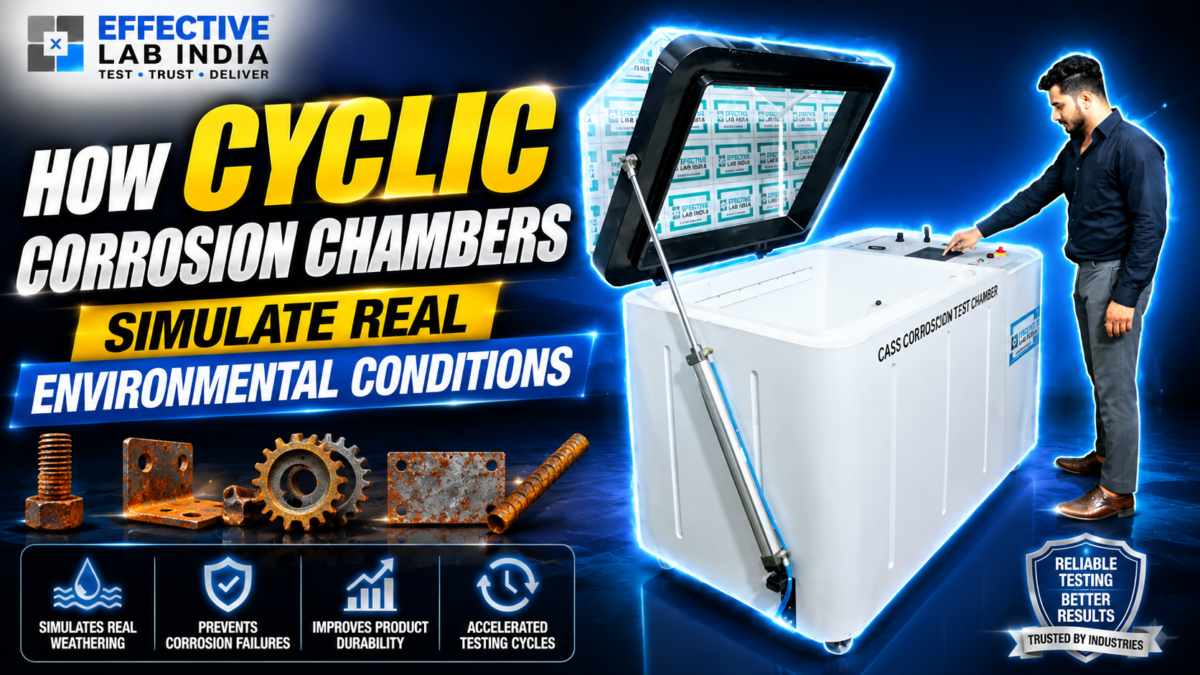
Cyclic Corrosion Chambers Simulate Real-World Environmental Conditions: Modern-day industrial goods are exposed to corrosive environments daily. The combination of rain, humidity, sea spray, and temperature fluctuations all act together to corrode the materials over time.
What makes matters even worse for producers is being able to predict how quickly the goods will deteriorate over time. It is at such times that a cyclic corrosion chamber comes in very handy indeed.
A cyclic corrosion chamber can be defined as an advanced instrument that simulates different environmental effects in a laboratory environment. The instrument is different from ordinary single-stage chambers in that it subjects samples to various phases, such as salt fog, condensation, and ambient drying, to produce test results comparable with what happens in nature. Therefore, this makes it the standard when it comes to testing for corrosion.
Effective Lab India offers services as the best cyclic corrosion chamber manufacturer in terms of consistent and repeatable tests that comply with international standards.
Understanding the Main Causes of Corrosion in Industrial Metals
Table of Content
- 1 Understanding the Main Causes of Corrosion in Industrial Metals
- 2 How a Cyclic Corrosion Chamber Replicates Natural Weather Conditions
- 3 Difference Between Salt Spray Corrosion Chamber and Cyclic Corrosion Chamber
- 4 Why Automotive and Coating Industries Prefer Cyclic Corrosion Testing
- 5 Conclusion: Importance of Realistic Corrosion Simulation in Modern Industries
- 6 Cyclic Corrosion Test Chamber FAQs
It is essential to have an understanding of the basic causes of corrosion to recognize the importance of cyclic corrosion testing. Corrosion refers to the electrochemical process that leads to metal deterioration due to interactions between the metal and its surrounding atmosphere. These are some factors that promote corrosion in industrial environments:
- Moisture and Humidity: Moisture provides an electrolyte medium that facilitates the electrochemical reaction leading to the formation of rust. Even moisture in small amounts can promote localized corrosion on the metal surface.
- Exposure to Salt: High concentrations of chloride ions from the marine environment, deicing salts, and other industrial sources increase the rate of corrosion by penetrating the protective coating of metal.
- Temperature Fluctuations: Temperature changes cause micro-cracks to form in the coatings of the metal, while condensation of moisture occurs on the metal surface.
- Concentration of Oxygen: The rate of oxidation reactions depends on oxygen content. Different oxygen concentrations over the surface area of the metal cause differential aeration cells.
- Contaminants and Pollutants: Metals used in industrial applications are usually subjected to sulphur dioxide, nitrogen oxides, and other pollutants in the atmosphere that could greatly accelerate their corrosion rate.
The use of cyclic corrosion chambers allows for the accelerated testing of how metals withstand such stresses by subjecting samples to them at a significantly reduced testing time period.
How a Cyclic Corrosion Chamber Replicates Natural Weather Conditions
What makes the cyclic corrosion chamber unique is its capability to go through programmed cycles that simulate atmospheric behaviour. In contrast to using a constant atmosphere, a cyclic corrosion chamber operates through various stages, each focused on a particular method of corrosion.
In a usual test cycle of the Effective Lab India Cyclic Corrosion Testing Chamber, these are the following stages:
- Salt Spray Stage: Fine droplets of NaCl solution are sprayed into the test specimens, thus simulating the conditions of being exposed to sea spray and road salt.
- High Humidity Stage: The chamber switches to a hot and humid condition with 95-100% relative humidity at a temperature of 40°C. This simulates tropical or rainy weather.
- Ambient Drying Stage: This is when the temperature decreases, with free airflow, simulating the action of the sun or low-humidity areas.
- Condensation Stage: In some tests, a condensation phase is included wherein moisture will condense on the cool surface of the test specimens.
The step-by-step process subjects the test sample to cumulative stress similar to that experienced under outdoor conditions for several months or even years, all within a matter of days or weeks. The Effective Lab India design ensures compliance with global standards such as VDA 233-102, SAE J2334, ASTM B117, and ISO 11997, thus gaining wide acceptance around the world.
These chambers have an automatic control system, a humidity control system, corrosion-resistant interiors, and user-friendly software. All chambers produced by Effective Lab India are tested extensively before delivery to ensure long-term durability and efficient operation.
Difference Between Salt Spray Corrosion Chamber and Cyclic Corrosion Chamber
A frequently asked question between quality engineers and procurement managers goes like this: What exactly makes a salt spray corrosion chamber different from a cyclic corrosion chamber? Although both chambers have something in common in terms of their purpose, there are a number of differences concerning methodologies used, applications, and even data quality generated from the tests.
Salt Spray Corrosion Chamber:
The salt spray corrosion chamber, also called a salt fog chamber or salt mist chamber, works on the principle of continuously subjecting the specimen to fine particles of salt solution at a constant temperature, which normally ranges around 35°C. This test is single-environment and steady-state, and is standardized by ASTM B117.
It is quite useful for ranking coating materials according to their durability and quality, although it doesn’t simulate weathering conditions. Continuous exposure to salt spray can actually inhibit some corrosion processes that occur during the cycle.
Cyclic Corrosion Chamber:
In contrast, a cyclic corrosion chamber goes through different environments in sequence programming. This method allows the replication of the corrosion process caused by weather cycling, such as underfilm corrosion, filiform corrosion, and galvanic corrosion at the coating interfaces. For this reason, the correlation achieved by using cyclic corrosion testing is much stronger than the one attained by conventional methods.
Laboratory Equipment India not only supplies both types of machines, but for those customers who want the best prediction, the cyclic corrosion chamber can be suggested, especially for the automotive industry and new coatings. Many worldwide OEMs and laboratories have switched from conventional salt spray corrosion chambers to cyclic testing due to this high correlation.
Why Automotive and Coating Industries Prefer Cyclic Corrosion Testing
Of all the industries involved with corrosion testing, the automotive and coatings industry stands out as the strongest adopter of the cyclic corrosion chamber. This is because:
Automotive Industry
The automobile industry has many metal parts exposed to one of the harshest corrosion environments. These include road salt, heat from the engine, water from the rain, and high-pressure cleaning. In the auto industry, all the parts, from a small bracket to the entire body-in-white structure, must adhere to strict corrosion performance specifications.
Tests such as the VDA 233-102 and Volvo STD 1027,3, conducted through a cyclic process, provide data that help in determining how well a part will resist corrosion over the years in use. Cyclic testing in Effective Lab India’s cyclic corrosion chambers will enable car manufacturers to validate designs, qualify coatings, and comply with OEM supplier specifications.
Paints and Coatings Industry
The capability to prove that your coating will provide excellent long-term corrosion protection is vital in order to sell any kind of coating – whether an industrial primer, marine top coat, or architectural finish. Cyclic corrosion testing reveals all the performance aspects of a coating: adhesion properties under conditions of moisture presence, under film creep resistance, and performance near coating flaws in a way that standard salt spray tests cannot.
Effective Lab India offers all necessary technical assistance to coatings manufacturers in developing test methods, evaluating results, and relating data obtained during testing to results of outdoor exposure trials. All their testing facilities comply with the main international standards in relation to cyclic corrosion testing of paints and varnishes – namely, ISO 11997 Parts 1 and 2.
Conclusion: Importance of Realistic Corrosion Simulation in Modern Industries
In the modern age, where quality, toughness, and safety are absolute essentials, accurate simulation of corrosion is essential rather than a luxury. The cyclic corrosion chamber is currently the best tool that can simulate corrosion under atmospheric conditions in laboratories, and its significance for manufacturing industries cannot be overemphasized.
It not only cuts costs in terms of time and money but also ensures the quality and reputation of any business by making sure there will be no warranty claims, recalls, or any other form of financial loss. Effective Lab India is a pioneer when it comes to manufacturing cyclic corrosion chambers in India. They have in-depth knowledge about metallurgy and engineering, and manufacture their products according to international standards.
Their product line includes both cyclic and salt spray corrosion chambers, which cater to the needs of businesses of all sizes. Effective Lab India ensures ISO compliance in all their products and provides excellent customer service with innovations in its product range.
When your company considers corrosion testing options, purchasing a cyclic corrosion test chamber from Effective Lab India is indeed an intelligent investment that will benefit your products and customers for many years to come.
Suggested Post:
Leading Laboratory Equipment Suppliers Offering Advanced Testing Solutions
Best Xenon Arc Weathering Test Chamber for Environmental Testing Labs
Cyclic Corrosion Test Chamber FAQs
Q1: What are the uses of a cyclic corrosion chamber?
A cyclic corrosion chamber performs a cyclic exposure test that evaluates the resistance of materials and coatings to environmental corrosion. This way, manufacturers can determine the durability of their products or coatings before launching.
Q2: What is the difference between a salt spray corrosion chamber and a cyclic corrosion chamber?
While a salt spray corrosion chamber exposes a material or coating to a constant salt fog atmosphere, a cyclic corrosion chamber performs a cycle of several steps that reproduce the natural environment.
Q3: Why select a cyclic corrosion chamber from Effective Lab India?
The company provides ISO-compliant chambers with a PLC controller system that supports international standards and has a good after-sales service record. They are suitable for coatings, the automobile industry, or industrial corrosion tests.
For More Information, please reach out to us.
Contact: (+91) 9555515525
Email: info@effectivelabindia.com
LinkedIn: Effective Lab India